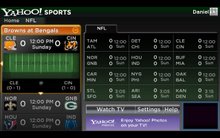
Active-TV Technology for iPhone and iPod touch

Active-TV Technology for iPhone and iPod touch
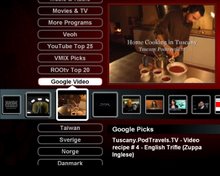
Navigate YouTube

Navigate YouTube available at iTunes App Sore

An easy to use iPhone and iPod touch App that enables both new and advanced YouTube users to get the best from YouTube.

Browse video Standard Feeds, Categories, Channels and Playlists. Then organize new videos into your own favorites and playlists. Make playlists private or public. Subscribe to other user's playlists and video collections for future viewing. Subscribe to videos matching search-words.

Look at publicly viewable favorite videos, playlists and subscriptions based on your YouTube friends, family and contacts. Send and receive video links with YouTube contacts via YouTube video messages.

Search for new videos tagged for your language or geographical region, using local keyboard. Explore for new videos via easy switching of user ID to the owner of interesting videos - then explore their world.

All actions are kept in sync with PC, Mac or Apple-TV access to YouTube. Available at Apple App Store.

active-TV technology for PC

active-TV technology for PC
Windows PC based home network
Showing posts with label advertising. Show all posts

Wednesday, April 2, 2008

Views and habits of the Amercian pay-TV consumer

The Issue: Will the lingering business models of the US Cable TV service providers be reapplied to the internet connected TV?

Solutions: With no broadly accepted solution to TV digital convergence, the Cable TV service providers are looking to expand their systems to satisfy their users’ demand for new digital services. They bring with them the business models of the US Cable TV industry.

Behind the scene: Active-TV technology combines the best of the TV industry (longevity, reliability, openness) with the best of the PC industry (computationally power, web 2.0 software technology, openness). By enabling the use of web 2.0 methods, active-TV technology is ideal for low-cost TV developers who wish to improve upon or circumvent US Cable TV business models.

Many analysts and developers anticipate mainstream TV users will have their TVs connected to the internet via residential broadband service, thereby enabling browsing of internet-delivered video or web pages formatted for the TV (i.e. TV-web). The success of the internet, added to US consumer familiarity with paying monthly fees for cable TV service, has contributed to speculation about what new revenue-generating services can be enabled by networked TVs.

An ABI Research report, “Pay-TV and the American Consumer” examines what new service may be offered (see "chart 1.6" below):


There seems much more desire to do a better job at “monetizing” (as the MBA’s say) the application of internet technology at the TV than was apparent when the PC first connected to the internet. For example: currently TV suppliers do not share in the revenue produced by video or ads consumed at the TV, they make their money from the retail purchase of the TV. Similarly, laptop computer suppliers don’t make any money from the owners’ viewing of advertising on webpages accessed by the laptop. However, there are some TV developers and US pay-TV suppliers, exploring how they can “share” in the video and ad revenue produced by an internet-connected TV.

PC and laptop users are already familiar with unrestricted PC-web browsing. However, to enforce these new monetizing strategies, it is usually suggested that the TV function with a portal service rather than have freedom to browse the internet. Video aggregators play a key role in the proposed portal strategy. These aggregators provide the video for the portal. If a networked TV is ‘locked’ to a portal then the TV supplier is in a good position to negotiate revenue sharing terms with the aggregator. The aggregator supplies the TV UI and hence via pre-run, or other display methods, is ideally able to also inject advertising.

Unproven is the TV buyer’s willingness to purchase a TV tied to portal service. Traditionally, a Set-Top Box (STB) could be tied to a particular service, but not a TV, which was expected to “tune” to any channel. Perhaps this is why Apple has not introduced an integrated Apple TV, assuming that like the current Apple TV box, the TV would be restricted in the internet URLs it could ‘tune-in’. Likely only Apple’s TV portal would be accessible (TV-web pages have a URL network address just like PC-web pages).

Turning to the ABI Research report: “Perhaps the truism that Chart 1.6 supports the most is that pay-TV providers have only a tenuous hold on the vast majority of their subscribers, and they are vulnerable to churn. Several respondents voiced their frustration with their service providers’ pricing. The following comments reflect customer discontent:

‘I feel that cable prices have become outrages.’ ” [ABI Research report]

The ABI analysts asked US TV users if they would pay for new features such as accessing email, communication features, interactive services, transferring content from a PC, viewing personal content, and much more. For example the report states, “an additional $20 might bring communications features such as instant messaging and the ability to read e-mail on the screen.” I think they mean for an additional $20 per month. I am surprised at their willingness to pay for TV features which are generally regarded as free when accessed from a PC or notebook computer. Possibly unknown to some of the survey responders is that today the purchase of an active-TV technology enabled box, such as the D-Link DSM-520, will bring many of these features and without the monthly fee. This is because the TV user is provided with unlocked web 2.0 technology.

All of the ABI suggested features can be enabled with widgets, Flash, HTML, AJAX and other familiar Web 2.0 methods; such as TV widgets which support social network communication at the TV. Given that TV developers are currently integrating active-TV technology which will shortly be available at retail, unless they all enable URL filtering, portal locking or some legal device, the TV purchaser will be able to choose a freer form of internet-video browsing and new TV feature selection. If my analysis is correct, the business models applied to the networked TV will be similar to those applied to the networked notebook computer rather than the US cable TV service.

The ABI report would be even more interesting if they had included in their survey questions about selecting new TV features via the monthly service fee STB-approach, versus the choose-your-own website laptop-approach. Some in the TV/STB industry suggest the TV user may prefer the familiarity and quality of the single TV UI provided by the closed portal service. They suggest the TV user will become confused and dissatisfied with the varying nature of websites. By that they mean PC-websites or TV-websites do not have to conform to any standards, anyone can build them and web 2.0 methods can be applied as desired by their developer and not the TV supplier. I look forward to what is produced by this chaos. I think the TV user will ultimately appreciate and benefit from this openness.

Feedback, corrections and comments welcome. Contact me for more information or support with active-TV technology development.
Daniel Mann

Tuesday, March 4, 2008

Social Networking and other Widgets delivered to the TV

The Issue: Widget use on the TV has become an increasingly popular topic. Constructing mini-programs in the form of “widget” chunks allows a user to select and assemble them according to individual preferences.

Solutions: There are several companies offering tools for widget construction. These tools make it easy to use the same widget on the PC desktop, website, social networking homepage or other location. Now these same widgets, when appropriate, can be used on the big TV screen by embedding them into a TV-web page.

Behind the scene: Active-TV technology delivers web 2.0 methods to the TV without requiring that a PC be embedded into the TV. This way, the TV remains an inexpensive, low maintenance, and long lived device; and by making use of a PC somewhere on the home network, widgets and other web technology are made fully available to the TV user.

In the past, widgets have been available to those TV users who connect their TV to the video-out port on their PC. But there has been little demand for a PC in the living room and hence little widget presence on the TV to date. Active-TV technology uses a PC-assisted approach to enable internet video browsing at the TV. Working with the yourminis company (recently acquired by AOL), I have enabled their widgets to appear on the TV browser and therefore on the TV. For example, see the bottom images (for weather and time) on a YouTube TV-web site (or internet video channel) below.


I have expanded the menu system to gain access to an RSS feed for widgets. Yourminis already has RSS feeds for widgets, but I had to expand these feeds to support embedding the widgets into TV-web channels. This is because there is no one currently serving TV home pages - A TV home page is a bit like Google’s a iGoogle PC home page, but for the TV. Yourminis supports embedding widgets into iGoogle, but there is no equivalent mechanism for embedding them into a TV-web page.

This problem is solved via a TV-web page having access to an RSS feed for widgets. Any personalization of the widget, such as colour, time zone or address codes, is stored in the form of cookies associated with the widget. As shown below, the menu normally used for video or photo access is also used for widget selection.


Widget information is available for preview before widget selection, as shown below.


The menu “Settings” page is used to select the widget RSS feed. In the example below, menu entry 3 is used to select yourminis widgets for screen position “widget 1”. This mechanism enables different widgets to be positioned at each widget location. Because each family member can have their own TV-web page setup, each user can have their own widget preferences, based on relevant cookies.


Navigation of the PC-web is via the TV IR remote, not the keyboard of mouse used by PC-web pages. Widgets which require keyboard or mouse interaction are not appropriate for TV-web use. Widgets also have to be larger and clearer, in case they are used by a TV with simple composite video cabling rather than high resolution video using an HDMI cable.

Video channels or individual videos can have click-to-view video advertising links; this is also true for widgets. Not released yet are widgets which interact with the menu system, such as a widget which supports “yes” or “no” voting, or other selective feedback to a video supplier or advertiser. Using the TV IR remote, a user can send a response via the TV’s internet return path.

Widgets associated with social networking interact with PC-web widgets and also support social network communication. One combination is using a laptop PC in the same room as the TV. A TV-web widget can receive messages, but without the support of a keyboard, its response is limited.

Feedback, corrections and comments welcome. Contact me for more information or support with active-TV technology development.
Daniel Mann

Monday, November 12, 2007

Living room TV advertising support for TV-web channels

The Issue: The ease with which Internet-delivered video can now reach the living room TV is certain to lead to renewed interest in new forms of advertising, assuming they complement, rather than detract, from TV-web viewing.

Solutions: Since Active-TV technology supports Web 2.0 technology, this allows PC-web based advertising techniques to be reapplied to TV-web channels.

Behind the scene: Click-to-view video advertising for TV-web is demonstrated using a new TV-web channel for vintage jazz enthusiasts. Given that a TV-web channel can potentially provide hours and hours of uninterrupted viewing, viewers should not be burdened with excessive or distracting advertising. Click-to-view advertising will have to be appealing.

Assuming a healthy balance is struck between the desires of viewers and the needs of advertisers, I suspect there may be music labels interested in associating their jazz CDs with vintage jazz video clips.
Terry Teachout, drama critic of the Wall Street Journal, shares an ARTSJOURNAL weblog on the arts in New York City. With over 4,500 blog entries, it is a busy site. In addition to daily postings, the site also features a list of mostly vintage American Jazz video clips uploaded to YouTube.

Oddly, Terry does not maintain a YouTube playlist for these videos per se, but I have nevertheless made a playlist from the links on his 'About Last Night' web site. Rather than single play, it is more convenient to watch the videos as one long uninterrupted sequence on the living room TV, as a 'jazz documentary' if you will. To enable this I have added new features to the TV-web template channel available at http://active-tv.blogspot.com/, making it easier to create a “YouTube Jazz” channel with these features. (See the TV image below.)


Under the “settings” option on the top horizontal menu, a feature to 'auto-play' the list of video can be selected. Below is a typical in-between videos TV image. This is displayed for a few seconds after the completion of the current video and automatically replaced by the next video in the sequence when the latter starts to play.


Below is an image of the next video playing. In practice, videos are not typically watched in the menu-context window shown; they are more likely watched in full-screen mode. The in-between video information ‘page’ is still briefly presented while transitioning between videos in full-screen mode.


As well as adding the 'auto play' option under the settings page (shown below), there are also new options to change the background color shading and select permanent left or right positioning of the box where the video plays on the menu page (instead of auto swapping at regular intervals).


There have been inquiries from readers as to how advertising could be included in TV-web channels. Google offers video AdSense for this task. AdSense is normally used with PC-web pages. It works by examining the contents (HTML code) of the page and delivering ads that are relevant. A block of HTML code must be inserted into the PC-web page to make calls to an AdSense server, which then delivers the video and adverting information displayed on the web page.

The same mechanism can be used with TV-web channels. To demonstrate this, I have added support code into the example TV-web channel. A small still-image appears in a box below the video viewport. When the advert-box is highlighted via screen navigation (as shown below), information provided by the advertiser is temporarily presented in the video-information area (below the video viewport).


If the user pushes ‘enter’ on the TV IR remote while the advert-image is highlighted then the associated ad video is played in the main viewport (a full-screen video-advert option is also supported). This is essentially “click-to-view” video advertising. If the user does not ‘click’ the ad image, they are not forced to watch the ad video and are only subjected to the still-image.

Naturally, the still-image, associated video, and text information are all supplied by an ad server such as AdSense. For the demo system, I just used YouTube video matching the search criteria “Trunk Monkey TV advert”. A new advert is requested from the server at frequent intervals such that the still image changes without any prompting from the user.

The word “advertisement” appearing below the advert-image is programmable by the HTML support code. In fact all advertising can be completely turned off (if so configured). The mechanism could likely be used for other purposes, such as distributing general announcements, displaying urgent news or maybe presenting an instant messaging session. These options will likely be explored here at a future date.

Feedback, corrections and comments welcome. Contact me for more information or support with active-TV technology development.
Daniel Mann

Wednesday, May 9, 2007

Adding a TV-web channel to a TV's channel list

Active-TV Ecosystem Developers,

The Issue: Can adding a TV-web channel to ‘TV favorites' be as easy as PC browsing ?

Background: TV-web channel developers are leveraging the naming and formatting conventions of Media Center and RSS syndication to ensure easy and consistent access to TV-web channels.

Behind the Scenes: A simple web-accessed button enables users to manage and gain access to new TV-web channels.

Whereas it is easy to add a PC-web page to the list of favorite or frequently used web pages -- as simple as clicking on ‘Favorites --> Add to Favorites --> OK’ in your Internet browser -- how is a TV-web channel added to the list of channels viewable on the TV ?

There are several methods available; I will present one below.

TV-web channels have a URL just like PC-web pages, but they are identified by icons, not text strings. As an example, let’s look at the Honda TV channel built by Honda U.K. and their media agency, Zype. The Honda TV-web channel is accessed over the internet and formatted for viewing on an active-TV enabled and networked TV or STB. Honda has several uses for the technology. Below is a TV screen-capture of the Honda TV-web channel.


[Note that Honda TV is formatted for a 16x9 widescreen TV, and unlike some channels, does not automatically adjust for viewing on a 4x3 TV.]

The Honda TV channel allows home users to view 'Honda TV' on their TVs. Included in the channel line-up are short 20 minute documentaries about current Honda car models, including news updates from Auto shows, as well as behind-the-scenes stories and new car videos.

Aside from attracting consumers to check out the latest offerings from Honda, active-TV technology has sparked what is being called “Dealer TV”. In-showroom TV-web channels can present model and ownership information to those visiting the showroom. Moreover, Honda U.K. can use TV-web channels to simultaneously broadcast training videos and corporate messaging to its dealer network. This approach is likely suited to other retail settings besides Honda.

Active-TV technology has followed the rules for TV-web channel addressing first set-out by the Media Center PC. This makes it particularly easy for active-TV enabled TVs to view TV-web channels originally intended for Media Center supported platforms. A TV-web channel can be viewed on a living room TV via an Xbox360 operating as an Extender. At the TV, the channel listing will be included under the More Programs menu. To get the channel to appear under the TV menu, it must first appear in the networked Extended-PC’s file system at the location C:\Documents and Settings\All Users\Start Menu\Programs\Accessories\Media Center\Media Center Programs. [There are other methods which are not covered here]

Digging into the technical specifics for this example, the PC file entry for Honda TV is named Honda.mcl looks like this:

<>
href="http://www.smarthomedesign.co.uk/honda/honda_home.htm">http://www.smarthomedesign.co.uk/honda/honda_home.htm
name="Honda TV"
thumbnailImage="http://www.smarthomedesign.co.uk/honda/images/honda_call_to_action.jpg" >
< / application>

MCL stands for Media Center Link. The MCL files contains three important lines which identify the URL for the TV-web channel, the name of the channel and the URL for the thumbnail image or icon which appears in the TV menu. The image used by Honda TV is shown bellow:


To make things convenient a simple mechanism is needed for installing the necessary MCL file. Such conveniences exist for accessing an RSS video or music feed via Apple iTunes. PC-web pages with the button are used to automatically add a conforming Pod stream to the iTunes listing. The button is used to connect popular syndication readers to a feed source. Similarly, the active-TV technology button can be used to add a TV-web channel to the channel listings.

Once a podcast has been added to the iTunes listings, the podcast can be accessed in a living room via a networked Apple TV. Similarly, a visitor to a Honda PC-web page, can select the button to have the Honda TV web channel added to the TV-web channel listing. Hence, when the user moves from their PC to their TV and examines the channel listings, the Honda TV icon is visible.

[The code used with the simple active-TV example above, has only been developed to support Windows XP platforms using Internet Explorer.]

Just one method for simply adding a TV-web channel to the channel listings has been described. The method is useful when a channel is discovered from an associated PC-web page. There are already mechanisms for adding a new TV-web channel which is discovered while watching an existing TV-web channel.

If you don't have a active-TV enabled TV or STB, but want to see how it looks on a TV, then download the evaluation software from active-TV technology collaborator MediaMall. They have put together a bundle of active-TV technology software which enables the PC to emulate the TV operation. The demo assumes a Windows XP or MCE PC, and no use of corporate domain networking. Navigation is via the left-right arrows and F12 is used for 'back'. The bundle uses their example menu system, but like PC-web pages, the appearance is easily changed or branded and other companies are also working on alternatives UIs and extensions.

Feedback, corrections and comments welcome.
Daniel Mann

Thursday, April 19, 2007

EchoStar and Google Partner for TV advertising

Active-TV Ecosystem Developers,

The Issue: Google wants to expand is PC-based advertising role to include TV advertising.
Background: Google applies its PC advertising analysis skills, along with automation improvements to place conventional linear-TV advertising using current EchoStar STB infrastructure.
Behind the scene: active-TV technology uses new generation of networked TVs and STBs to deliver, more innovative and PC-like, TV-web in support nonlinear-TV advertising.

Google has a significant position in support of PC-web advertising. Recent announcements add to reports that it wants to expand its position to include TV advertising (a $60B per year business).

Through web access information, cookies and other browser provided information; Google can help place PC-web adverts that are relevant to the PC user. Like all browsing information, the adverts are delivered over the PC’s internet connection. The Set-Top Box and advanced TV market is entering the initial adoption phase for the networked enabled STB and TV. Consequently, Google can not yet use IP networking to deliver TV adverts to an existing and large TV audience.

EchoStar is marketed as Dish Network in the US and has 13.1M satellite subscribers. (The press release linked below, also indicates Google are collaborating with some smaller cable TV operators.) The Google press release states “Advances in set-top-box technologies make it possible to report aggregate statistics on how many times an ad was viewed and whether it was watched through to the end.”
The return path for a satellite STB is normally the telephone. Typically, late at night the STB will dial a reporting center and transfer information about its daily activity. This information will be passed by EchoStar to Google in what is described at “aggregate, anonymized set-top-box metrics”.

Google inserts adverts into the broadcast stream. This is conventional linear TV advertising. Likely using PC-web back-end advertising support technology Google already has in place, and access to return-path data, Google will “automate” the process of inserting linear TV adverts. The objective is to make adverts more relevant to the target TV viewers. Google’s experience in analyzing PC-web behavior may help in analyzing TV viewer behavior.

There is no push-red style TV interactivity indicated in the current press release. A STB supported by more advanced middleware such as from http://www.emusetechnologies.com/ or the like, would enable Google to support more advanced form is TV advertising.

Active-TV collaborators have used the IP path to support new forms of TV advertising. Red Bee Media (BBC Broadcasting spin-off) has publicly demonstrated push-red style interactive advertising using overlay TV-web, an active-TV technology. At last November’s BIMA (British Interactive Media Association) award ceremony, Red Bee won Best Use of Interactive Television for their Boots Christmas i-ad.

With active-TV technology, TV advertising is not in the linear broadcast stream, but supplied over the internet. However, the advertising can be synchronized to the broadcast TV schedule. A push-red style semitransparent TV-web image is overlaid on the broadcast image. User interactivity normally results in video redirection to an IP delivered TV-web channel stream which contains the advertising material.

The active-TV technology approach to TV advertising significantly differs from the current EchoStar-Google approach in that it does not require advert insertion into the linear broadcast stream. However, it does require adoption of a networked TV or a networked STB. Use of the IP path rather than the broadcast path for advertising support, does result in a more open approach. Those wishing to play a role in TV advertising can find it hard to make deals with closed STB service providers.

The relative openness of PC-web and TV-web technology, is better suited to supporting competition among advertising suppliers. In the retail STB and advanced TV market, purchasers are interested in free-to-air broadcast shows and, increasingly, access to free video sharing or other interesting TV-web channels. The role of the search-engine may remain a PC-web activity and not TV-web, as there is little interest in having a keyboard attached to a TV. It is more convenient to use, as necessary, a laptop PC in the same room as the TV. This may diminish the role of the search-engine in support of TV advertising. However, combining analysis of PC-web and TV-web activity may be the most powerful tool in making TV advertising more relevant.

Feedback, corrections and comments welcome.
Daniel Mann
EchoStar and Google Partner on New TV Advertising System http://www.google.com/intl/en/press/pressrel/echostar.html

Google Announces TV Ads Trial http://www.google.com/intl/en/press/annc/tv_ads_trial.html

Tuesday, October 3, 2006

Red Bee Showcases IPTV i-Ad via active-TV

Active-TV Ecosystem Developers,

Linked below is a report on the overlay TV-web demonstration by Red Bee at IBC. The reporter summaries the terminology well with the expression: “the prototype was running on a Futarque set-top with AMD's ActiveTV software; the set-top was connected in turn to an Internet-connected AMDLive! PC”.

The active-TV approach uses the PC’s browser to process the TV-web material ultimately presented at the hybrid-STB’s TV. The method avoids many of the “technical constraints” limiting a STB acting alone.

TV advertising is a $60B business in the US. The business is changing due to new consumer technology (DVR and TCP-IP) and new consumer behaviour. The use of TV-web channels and overlay TV-web are technical- and cost-effective new solutions.

Much, or maybe most, of the PC industry has struggled to position the PC-in-the-living-room as the platform-solution to the changes occurring with TV entertainment. The focus has also been on using computer networking to deliver an IP-TV alternative source of Hollywood-type content. No matter that this material is already widely available from several existing distribution channels.

Consequently, there has been more discussion about DTCP-IP content protection than new forms of TV advertising. I suggest there has been too much focus on offering alternative platforms supporting familiar forms of content consumption – merely using a new IP distribution method. Of more importance is developing lower-cost platform-solutions which address the changing nature of consumer behaviour. I suggest, this line of thinking, makes overlay TV-web more interesting than TCP-IP content protection.

Linked is an interesting US study entitled “The New ‘Digital Divide’, How the New Generation of Digital Consumers are Transforming Mass Communication.” Although much of the study is about PC-web behaviour, there are clearly implications for TV audiences and TV advertising – particularly given the emergence of active-TV technology.

[quote from New Digital Divide linked below]
“There is no doubt that we are moving rapidly from a world of passive receptivity to active engagement. No longer can we simply broadcast our messages to a mass audience and hope that our standard metrics of reach and frequency will guarantee success. Accountable engagement innovation is the battlefield of the 21st century”
  • The age group 16-34 is 25% more likely than ages 35-49 to use instant messenger, with over 75% of ages 16-34 currently using at least one service.
  • About 40% age P16-34 belong to a social network site; this is twice the percentage of 35-49 year olds.
  • 71% of the 16-34 year olds have participated in a blogging activity.
  • One third of 16-34's have participated in peer-to-peer file sharing compared to just 12% of those 35-49. [end]
Active-TV enables the STB to display TV-web with the same universal access and opportunity available to the PC with PC-web. Unless locked via a closed-garden approach, the hybrid-STB with active-TV makes it very easy for PC-web innovations (such as messaging, video sharing and social networking) to appear in TV-web form.

Comments, corrections and feedback welcome.

more at http://universalmccann.com/downloads/papers/The%20New%20Digital%20Divide.pdf
and http://blog.itvt.com/my_weblog/2006/09/red_bee_showcas.html

Tuesday, May 9, 2006

Advertising revenue moving to non-linear TV

Active-TV ecosystem developers,

Grocery brand advertising budgets are not the size of an auto maker, but the announcement below indicates that smaller-scale advertisers are also moving away from traditional linear-TV advertising methods.

Increasingly, brand promoters are stating non-linear advertising better supports a lifestyle-messaging approach. A mini-DAL (Dedicated Advertiser Location) allows the viewer to depart from normal broadcast viewing and enter a dedicated advertising content area. Platforms such as BSkyB’s Sky-Active interactive TV support this.

“Viewers 'jump' to the DAL or Mini-DAL from a broadcast commercial through an interactive button or from a banner in an interactive service.”

These kinds of UI operation are easily supported by an active-TV hybrid-STB. The DAL takes the form of an IP-TV channel; the “jump” is taken from an overlay media application presenting a banner (or the like) over the broadcast image.

If you want to see DAL advertising in action, take a look at http://www.idigitalsales.co.uk/html_content/images/mpegs/bmwseries1.mpg The video is a capture of a TV screen; first shown is the linear BMW advertisement, then the video shows the jump-banner and the DAL channel -- Bit of a ‘change’ for many US TV viewers.

The active-TV hybrid-STB and extended-Notebook are well placed to support these new forms of advertising.

Feedback, corrections and comments welcome.

more at http://blog.itvt.com/my_weblog/2006/05/uks_bernard_mat.html

Thursday, March 23, 2006

TV advertising set for massive slump

Active-TV ecosystem developers,

The shift in TV advertising due to the increasing availability of the Digital Video Record (DVR), is a growing topic of concern for advertisers. The Extended-PC and Extended-Notebook’s role in support of new forms of advertising is important. This is the reasoning behind the development of overlay media applications, synchronised to IP or broadcast content. The PC’s overlay media application carries the advertising material. It is also the “push red” entry into interactive TV and promotional IP-TV channels.

Many of the technologies used in 2’ advertising, supported by the PC browser, are likely to make their way to the 10 location via Extended-Notebook browser projection. The Extended-PC with active-TV technology is positioned to support the transition to new forms of advertising. Ecosystems supporting this are likely to have greater access to content paid for via advertising revenue. They may also cost less due to advertising and brand promotion subsidies.


more at http://www.brandrepublic.com/bulletins/br/article/548813/tv-advertising-set-massive-slump-us-research-says/