Active-TV Technology for iPhone and iPod touch

Active-TV Technology for iPhone and iPod touch
Navigate YouTube

Navigate YouTube available at iTunes App Sore

An easy to use iPhone and iPod touch App that enables both new and advanced YouTube users to get the best from YouTube.

Browse video Standard Feeds, Categories, Channels and Playlists. Then organize new videos into your own favorites and playlists. Make playlists private or public. Subscribe to other user's playlists and video collections for future viewing. Subscribe to videos matching search-words.

Look at publicly viewable favorite videos, playlists and subscriptions based on your YouTube friends, family and contacts. Send and receive video links with YouTube contacts via YouTube video messages.

Search for new videos tagged for your language or geographical region, using local keyboard. Explore for new videos via easy switching of user ID to the owner of interesting videos - then explore their world.

All actions are kept in sync with PC, Mac or Apple-TV access to YouTube. Available at Apple App Store.

active-TV technology for PC

active-TV technology for PC
Windows PC based home network
Showing posts with label interactive TV. Show all posts

Wednesday, May 9, 2007

Adding a TV-web channel to a TV's channel list

Active-TV Ecosystem Developers,

The Issue: Can adding a TV-web channel to ‘TV favorites' be as easy as PC browsing ?

Background: TV-web channel developers are leveraging the naming and formatting conventions of Media Center and RSS syndication to ensure easy and consistent access to TV-web channels.

Behind the Scenes: A simple web-accessed button enables users to manage and gain access to new TV-web channels.

Whereas it is easy to add a PC-web page to the list of favorite or frequently used web pages -- as simple as clicking on ‘Favorites --> Add to Favorites --> OK’ in your Internet browser -- how is a TV-web channel added to the list of channels viewable on the TV ?

There are several methods available; I will present one below.

TV-web channels have a URL just like PC-web pages, but they are identified by icons, not text strings. As an example, let’s look at the Honda TV channel built by Honda U.K. and their media agency, Zype. The Honda TV-web channel is accessed over the internet and formatted for viewing on an active-TV enabled and networked TV or STB. Honda has several uses for the technology. Below is a TV screen-capture of the Honda TV-web channel.


[Note that Honda TV is formatted for a 16x9 widescreen TV, and unlike some channels, does not automatically adjust for viewing on a 4x3 TV.]

The Honda TV channel allows home users to view 'Honda TV' on their TVs. Included in the channel line-up are short 20 minute documentaries about current Honda car models, including news updates from Auto shows, as well as behind-the-scenes stories and new car videos.

Aside from attracting consumers to check out the latest offerings from Honda, active-TV technology has sparked what is being called “Dealer TV”. In-showroom TV-web channels can present model and ownership information to those visiting the showroom. Moreover, Honda U.K. can use TV-web channels to simultaneously broadcast training videos and corporate messaging to its dealer network. This approach is likely suited to other retail settings besides Honda.

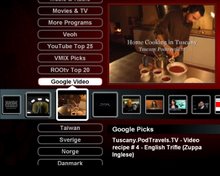
Active-TV technology has followed the rules for TV-web channel addressing first set-out by the Media Center PC. This makes it particularly easy for active-TV enabled TVs to view TV-web channels originally intended for Media Center supported platforms. A TV-web channel can be viewed on a living room TV via an Xbox360 operating as an Extender. At the TV, the channel listing will be included under the More Programs menu. To get the channel to appear under the TV menu, it must first appear in the networked Extended-PC’s file system at the location C:\Documents and Settings\All Users\Start Menu\Programs\Accessories\Media Center\Media Center Programs. [There are other methods which are not covered here]

Digging into the technical specifics for this example, the PC file entry for Honda TV is named Honda.mcl looks like this:

<>
href="http://www.smarthomedesign.co.uk/honda/honda_home.htm">http://www.smarthomedesign.co.uk/honda/honda_home.htm
name="Honda TV"
thumbnailImage="http://www.smarthomedesign.co.uk/honda/images/honda_call_to_action.jpg" >
< / application>

MCL stands for Media Center Link. The MCL files contains three important lines which identify the URL for the TV-web channel, the name of the channel and the URL for the thumbnail image or icon which appears in the TV menu. The image used by Honda TV is shown bellow:


To make things convenient a simple mechanism is needed for installing the necessary MCL file. Such conveniences exist for accessing an RSS video or music feed via Apple iTunes. PC-web pages with the button are used to automatically add a conforming Pod stream to the iTunes listing. The button is used to connect popular syndication readers to a feed source. Similarly, the active-TV technology button can be used to add a TV-web channel to the channel listings.

Once a podcast has been added to the iTunes listings, the podcast can be accessed in a living room via a networked Apple TV. Similarly, a visitor to a Honda PC-web page, can select the button to have the Honda TV web channel added to the TV-web channel listing. Hence, when the user moves from their PC to their TV and examines the channel listings, the Honda TV icon is visible.

[The code used with the simple active-TV example above, has only been developed to support Windows XP platforms using Internet Explorer.]

Just one method for simply adding a TV-web channel to the channel listings has been described. The method is useful when a channel is discovered from an associated PC-web page. There are already mechanisms for adding a new TV-web channel which is discovered while watching an existing TV-web channel.

If you don't have a active-TV enabled TV or STB, but want to see how it looks on a TV, then download the evaluation software from active-TV technology collaborator MediaMall. They have put together a bundle of active-TV technology software which enables the PC to emulate the TV operation. The demo assumes a Windows XP or MCE PC, and no use of corporate domain networking. Navigation is via the left-right arrows and F12 is used for 'back'. The bundle uses their example menu system, but like PC-web pages, the appearance is easily changed or branded and other companies are also working on alternatives UIs and extensions.

Feedback, corrections and comments welcome.
Daniel Mann

Thursday, April 19, 2007

EchoStar and Google Partner for TV advertising

Active-TV Ecosystem Developers,

The Issue: Google wants to expand is PC-based advertising role to include TV advertising.
Background: Google applies its PC advertising analysis skills, along with automation improvements to place conventional linear-TV advertising using current EchoStar STB infrastructure.
Behind the scene: active-TV technology uses new generation of networked TVs and STBs to deliver, more innovative and PC-like, TV-web in support nonlinear-TV advertising.

Google has a significant position in support of PC-web advertising. Recent announcements add to reports that it wants to expand its position to include TV advertising (a $60B per year business).

Through web access information, cookies and other browser provided information; Google can help place PC-web adverts that are relevant to the PC user. Like all browsing information, the adverts are delivered over the PC’s internet connection. The Set-Top Box and advanced TV market is entering the initial adoption phase for the networked enabled STB and TV. Consequently, Google can not yet use IP networking to deliver TV adverts to an existing and large TV audience.

EchoStar is marketed as Dish Network in the US and has 13.1M satellite subscribers. (The press release linked below, also indicates Google are collaborating with some smaller cable TV operators.) The Google press release states “Advances in set-top-box technologies make it possible to report aggregate statistics on how many times an ad was viewed and whether it was watched through to the end.”
The return path for a satellite STB is normally the telephone. Typically, late at night the STB will dial a reporting center and transfer information about its daily activity. This information will be passed by EchoStar to Google in what is described at “aggregate, anonymized set-top-box metrics”.

Google inserts adverts into the broadcast stream. This is conventional linear TV advertising. Likely using PC-web back-end advertising support technology Google already has in place, and access to return-path data, Google will “automate” the process of inserting linear TV adverts. The objective is to make adverts more relevant to the target TV viewers. Google’s experience in analyzing PC-web behavior may help in analyzing TV viewer behavior.

There is no push-red style TV interactivity indicated in the current press release. A STB supported by more advanced middleware such as from http://www.emusetechnologies.com/ or the like, would enable Google to support more advanced form is TV advertising.

Active-TV collaborators have used the IP path to support new forms of TV advertising. Red Bee Media (BBC Broadcasting spin-off) has publicly demonstrated push-red style interactive advertising using overlay TV-web, an active-TV technology. At last November’s BIMA (British Interactive Media Association) award ceremony, Red Bee won Best Use of Interactive Television for their Boots Christmas i-ad.

With active-TV technology, TV advertising is not in the linear broadcast stream, but supplied over the internet. However, the advertising can be synchronized to the broadcast TV schedule. A push-red style semitransparent TV-web image is overlaid on the broadcast image. User interactivity normally results in video redirection to an IP delivered TV-web channel stream which contains the advertising material.

The active-TV technology approach to TV advertising significantly differs from the current EchoStar-Google approach in that it does not require advert insertion into the linear broadcast stream. However, it does require adoption of a networked TV or a networked STB. Use of the IP path rather than the broadcast path for advertising support, does result in a more open approach. Those wishing to play a role in TV advertising can find it hard to make deals with closed STB service providers.

The relative openness of PC-web and TV-web technology, is better suited to supporting competition among advertising suppliers. In the retail STB and advanced TV market, purchasers are interested in free-to-air broadcast shows and, increasingly, access to free video sharing or other interesting TV-web channels. The role of the search-engine may remain a PC-web activity and not TV-web, as there is little interest in having a keyboard attached to a TV. It is more convenient to use, as necessary, a laptop PC in the same room as the TV. This may diminish the role of the search-engine in support of TV advertising. However, combining analysis of PC-web and TV-web activity may be the most powerful tool in making TV advertising more relevant.

Feedback, corrections and comments welcome.
Daniel Mann

EchoStar and Google Partner on New TV Advertising System http://www.google.com/intl/en/press/pressrel/echostar.html

Google Announces TV Ads Trial http://www.google.com/intl/en/press/annc/tv_ads_trial.html

Monday, April 16, 2007

S&T to Demo MHEG-based TV Interactivity

Active-TV Ecosystem Developers,

The Issue: enabling TV interactivity via low-cost networked-STB technology.
Background: combing network access with STB MHEG-5 standard, improves support for interactivity.
Behind the scene: active-TV technology is similarly low-cost, but offers more advanced TV interactivity and access to networked-delivered TV-web video.


Contained in the S&T press release, is some interesting MHEG-5 and TV interactivity news.

S&T’s supply the tools needed to build carousel-style TV interactivity. The interactive material (the “broadcast file system”) is sent to the Set-Top Box in the MPEG2 transport stream. S&T also supply their RedKey MHEG-5 STB middleware; which seems currently supported by ST, ARM and possibly Zoran STB solutions.

A TV EPG (electronic program guide) is a typical MHEG-5 application. However, somewhat more advanced applications are possible, giving the TV user a limited amount of interactivity. Without an on-line return path, typically phone SMS based methods are used to complete any additional transactions.

A networked STB with RedKey MHEG-5 middleware can extend access from the “broadcast file system” to the “networked file system”. This improves its ability to support MHEG-5 compliant applications. The IP network eliminates the use of SMS for return path transactions.

MHEG-5 platforms are generally much less expensive than MHP (or OCAP) alternatives – which also typically have no return path. Given consumes’ rapid acceptance of broadband ISP service at home, this simple return path mechanism and expansion of MHEG-5 applications, may give these relatively low-cost STBs further market acceptance.

The RedKey middleware does not give the TV or STB, conventional access to the internet. The method does improve a STBs standalone capability, but MPEG-5 applications can not compete in complexity with active-TV technology’s PC-assisted applications. The STB also does not network with any home PC or notebook PC, enabling sharing of content.

Presumably, the interactive MHEG-5 STB can connect to the home router via wireless network support. I suggest consumers, would clearly appreciate wireless connection and interaction with the home laptop PC. At which point, support for TV-web channel applications, in advance of the more basic MHEG-5 applications, would be a much appreciated addition and add little to the cost of the STB.

Without this enhancement, the networked MHEG-5 STB does not allow the TV viewer to reach the increasing number of interesting TV-web channels. These “channels” give the TV user the freedom to access and share internet video and PC-resident content; A freedom, familiar to the PC user when accessing PC-web.

Feedback, corrections and comments welcome.

Tuesday, October 3, 2006

Red Bee Showcases IPTV i-Ad via active-TV

Active-TV Ecosystem Developers,

Linked below is a report on the overlay TV-web demonstration by Red Bee at IBC. The reporter summaries the terminology well with the expression: “the prototype was running on a Futarque set-top with AMD's ActiveTV software; the set-top was connected in turn to an Internet-connected AMDLive! PC”.

The active-TV approach uses the PC’s browser to process the TV-web material ultimately presented at the hybrid-STB’s TV. The method avoids many of the “technical constraints” limiting a STB acting alone.

TV advertising is a $60B business in the US. The business is changing due to new consumer technology (DVR and TCP-IP) and new consumer behaviour. The use of TV-web channels and overlay TV-web are technical- and cost-effective new solutions.

Much, or maybe most, of the PC industry has struggled to position the PC-in-the-living-room as the platform-solution to the changes occurring with TV entertainment. The focus has also been on using computer networking to deliver an IP-TV alternative source of Hollywood-type content. No matter that this material is already widely available from several existing distribution channels.

Consequently, there has been more discussion about DTCP-IP content protection than new forms of TV advertising. I suggest there has been too much focus on offering alternative platforms supporting familiar forms of content consumption – merely using a new IP distribution method. Of more importance is developing lower-cost platform-solutions which address the changing nature of consumer behaviour. I suggest, this line of thinking, makes overlay TV-web more interesting than TCP-IP content protection.

Linked is an interesting US study entitled “The New ‘Digital Divide’, How the New Generation of Digital Consumers are Transforming Mass Communication.” Although much of the study is about PC-web behaviour, there are clearly implications for TV audiences and TV advertising – particularly given the emergence of active-TV technology.

[quote from New Digital Divide linked below]
“There is no doubt that we are moving rapidly from a world of passive receptivity to active engagement. No longer can we simply broadcast our messages to a mass audience and hope that our standard metrics of reach and frequency will guarantee success. Accountable engagement innovation is the battlefield of the 21st century”
  • The age group 16-34 is 25% more likely than ages 35-49 to use instant messenger, with over 75% of ages 16-34 currently using at least one service.
  • About 40% age P16-34 belong to a social network site; this is twice the percentage of 35-49 year olds.
  • 71% of the 16-34 year olds have participated in a blogging activity.
  • One third of 16-34's have participated in peer-to-peer file sharing compared to just 12% of those 35-49. [end]
Active-TV enables the STB to display TV-web with the same universal access and opportunity available to the PC with PC-web. Unless locked via a closed-garden approach, the hybrid-STB with active-TV makes it very easy for PC-web innovations (such as messaging, video sharing and social networking) to appear in TV-web form.

Comments, corrections and feedback welcome.

more at http://universalmccann.com/downloads/papers/The%20New%20Digital%20Divide.pdf
and http://blog.itvt.com/my_weblog/2006/09/red_bee_showcas.html

Wednesday, July 26, 2006

Building TV viewership

Active-TV Ecosystem Developers,

Using the cell phone to interact with a broadcast TV show is becoming increasingly familiar to TV audiences. There has been a lot of discussion about its use in building viewership and loyalty. The linked Wall Street Journal article covers several of these points.

The PC-web is also used in support of broadcast programming. But, unlike the STB, the PC is not normally used to access a broadcast show. PC-web material is accessed out with the broadcast time-slot and from a PC rather than living room TV. The article states “the cell phone is the best way to make television interactive because you can participate without getting out of the couch”.

With the adoption of the hybrid-STB and hybrid-TV, the IP path is likely to replace the cell phone as the technology supporting viewer “involvement”. The hybrid-STB enables TV-web pages in support of a broadcast show to be accessed from the living room. Also of interest is overlay TV-web (semi-transparent TV-formatted web pages overplayed on broadcast scenes); they will provide content creators, broadcasters and promoters with a much more productive method to build viewership and audience loyalty.

One challenge may be to keep the TV “experience” a mostly passive one while adding IP supported features. However, viewer behaviour is not easily predicted. Reality TV producers tell me there is a passive audience that wants to watch the response of a smaller number of interactive audience – it becomes part of the show, but remains passive for most.

Feedback, corrections and comments welcome.

more at http://users1.wsj.com/lmda/do/checkLogin?mg=evo-wsj&url=http%3A%2F%2Fonline.wsj.com%2Farticle%2FSB115336109951711994.html%3Fmod%3Dmm_media_marketing_hs_left