Active-TV Technology for iPhone and iPod touch

Active-TV Technology for iPhone and iPod touch
Navigate YouTube

Navigate YouTube available at iTunes App Sore

An easy to use iPhone and iPod touch App that enables both new and advanced YouTube users to get the best from YouTube.

Browse video Standard Feeds, Categories, Channels and Playlists. Then organize new videos into your own favorites and playlists. Make playlists private or public. Subscribe to other user's playlists and video collections for future viewing. Subscribe to videos matching search-words.

Look at publicly viewable favorite videos, playlists and subscriptions based on your YouTube friends, family and contacts. Send and receive video links with YouTube contacts via YouTube video messages.

Search for new videos tagged for your language or geographical region, using local keyboard. Explore for new videos via easy switching of user ID to the owner of interesting videos - then explore their world.

All actions are kept in sync with PC, Mac or Apple-TV access to YouTube. Available at Apple App Store.

active-TV technology for PC

active-TV technology for PC
Windows PC based home network
Showing posts with label Adobe. Show all posts

Tuesday, September 1, 2009

An "iTunes moment” for the TV ?

The Issue: Speaking at the MediaGuardian Edinburgh International Television Festival, the well informed Ashley Highfield’s remarks imply that the TV industry has as little as two years to create a viable digital businesses or face the TV equivalent of an "iTunes moment”. Which others have described as record labels ceding control over digital asset distribution to the Apple juggernaut.


Background: After years of effort by many companies to combine TV and Internet, no widely accepted video appliance or networked-TV has emerged. Does Highfield see that this is about to change? Is Apple now positioned for a dominant position in the TV platform and service business? Or is Highfield referring to something other than Apple technology?


Behind the scene: Apple is rumored to soon introduce a new ‘iPad’ (i.e. large Apple Touch). A new Apple-TV is also expected. Are these the platforms that will finally bring convergence between web and TV? Highfield opines, "Once this happens the shift of spending from TV to web will accelerate even more".


It has been two years since blogging began on possible next-steps for the Apple-TV. In this time Apple has made great strides in feeding expectations for extensive software application support on smart phones. This has caused the established hardware-oriented phone builders to scramble to develop their own software application infrastructure. Efforts, such as Android and Ovi are manifestly attempts to protect against further erosion of the high-end mobile phone market to the iPhone onslaught. This erosion has initially been most noticeable in the US market but soon to follow elsewhere.


The iPod has also developed into a software application platform in the form of the Apple Touch. Both Touch and iPhone support a “full browser” experience based on WebKit, and also application software programs built using the Apple SDK. Building a Pad-like device based on the same technology would enable Apple to build a lower-cost web access or web-browsing device without underselling its existing MacBook market and with access to the extensive catalogue of iPhone applications (some 60,000+ strong). What might be called an ‘iPad” could not support the full range of applications supported by a Mac or MacBook, but would nevertheless offer a compelling Internet and application enhanced appliance.


The original Apple-TV was based on PC technology. This has a much higher hardware cost than a Touch. The Apple-TV does not make use of this additional hardware capability; it’s a cost tax without major benefit. Now, however, Apple would appear to have the technology to build a next-generation Apple-TV based on Touch technology instead, which would likely require better graphics resolution for the larger TV screen. This development step is likely required for an iPad device as well.


A lower-cost Apple-TV could make headway in the US market where consumers are accustomed to subsidized Set-Top Boxes from service providers, and hence are very price sensitive. Following the recent U.S. transition to digital ATSC from analog NTSC broadcasts, Apple may decide the time is now right to introduce a Touch-based Apple-TV with ATSC support. This hybrid box, would meet demand for media convergence capabilities within a relatively low-cost appliance. Clearly, the European market would require a DVB-t hybrid, but Apple is likely to lead with US products first.


The lower cost hardware would also better support a co-branded networked Apple-TV with Touch technology “built into the glass” (as they say in “industry-speak”). With these steps, Apple will have moved the modern TV to a software application platform, much like it is moving the mobile phone to a software platform. Many of the existing TV and STB suppliers would struggle to respond. I suspect a large portion of the “window in which to respond” that Highfield refers to would be consumed while waiting for company accountants to confirm loss of market share. Thus making it safe in these difficult career times for product managers to engage in reactive-product development. Apple would have lit the green light, signaling the rush of competitive new products.


Highfield stated, "So, realistically, I think the industry has about two to three years to adapt or face its iTunes moment. And it will take at least that long for media brands to build credible, truly digital brands. But, importantly, I do believe TV does have a small, two to three year window in which to respond…"


Software application developers benefit from the efficiencies of a common platform such as the PC. The PC’s dominance is why we see new applications such as the iPlayer first appearing on the PC, even before the Mac. It is simply a matter of quickly reaching the greatest number of users. A common TV platform based on some form of Apple-TV would rapidly gain the attention of application developers. This assumes the new Apple-TV supports iTunes store-enabled applications. Albeit, with Apple having the final say on what applications are acceptable - this is likely to lead to some conflicts. Without some degree of support for independent application developers, the new Apple-TV would not be considered a common platform. Consequently, it would have a slower market acceptance and pose less threat to its competitors, and therefore extend the window in which to respond.


An Apple-TV which only supports iTunes would give Apple greater control over revenues generated by web-TV convergence. It would also simplify any competitor’s ability to rally the software community to support an alternative approach and platform. This might be based on a WebKit- or Adobe Flash-based range of boxes and TVs. However, the industry’s reluctance to embrace software technology has resulted in years of waiting for the ideal convergence TV platform. The failure to make do with technology now readily available is now likely a greater problem than mastering the business changes inherent with convergence. Again, this may well play to Apple’s advantages by keeping the software community fully occupied developing new applications for the iPhone, Touch, ‘iPad’, or any new Apple-TV.


Apple also has the opportunity to combine the operation of the iPhone or Touch with the PC or Mac and the Apple TV. Ecosystem-enabled smart application software holds the promise of finding relevance with web-savvy consumers and service providers. It will be interesting to see how Apple balances decisions regarding conflicting agendas for openness, exclusivity, and inclusion of non-revenue generating features, such as digital recording and ATSC tuners, or DVD playing. To achieve market dominance it has to ease new ideas into a wide audience which still finds value in existing, low-cost and well-understood TV-related appliances. Both Microsoft and Sony have not found this an easy nut to crack, despite major undertakings using their game platforms.


We should know soon whether the iPad is launched and the Apple-TV receives a refresh, and if Ashley Highfield’s predictions prove correct, the clock is ticking for competitors to make the next move.


Daniel Mann

Monday, December 29, 2008

Anouncing a UI for an internet TV using Lua run-time support

Active-TV Technology now offers an internet TV UI based on the Lua language and run-time support routines from CoreCodec. The Lua scripting tools currently enable a UI with abilities somewhere between MHEG5 and Adobe Flash.

CoreCodec is known for its CorePlayer, which supports “multimedia content on your desktop, mobile phone, portable media player, PDA, GPS, or convergence device”. It is widely used in the cell phone industry. Now, CoreCodec are in the process of retargeting their new Lua run-time environment to customers’ TV system-on a chip (Soc). They have already provided Lua run-time support for BroadQ’s Sony Playstation 2 project. Lua has particularly light-weight support requirements, and is popular in the video game industry.

Adobe’s Flash is widely used in the PC industry, when building web interface applications. Its availability for TV UI development would be greatly appreciated; given its productivity, capability and familiarity. The new CE3100 TV SOC from Intel has an advantage when supporting Flash due to the CE3100’s X86 processor core. Other, possibly lower cost TV SoC, will have a harder time supporting Flash. Using Lua may be the answer to competing with the CE3100.

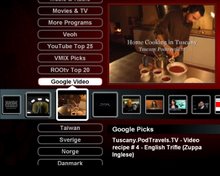
Below is a TV screen image of the current Lua-based YouTube interface.
Daniel Mann

Monday, July 7, 2008

Google to support the living room TV

The Issue: Google and others want a role to play in support of the living room TV. But how are TVs developing such that Google can have a role.

Behind the scene: Most if not all TV manufacturers are developing models with network support. These UPnP TVs enable media to be transferred between the TV and other networked PCs, appliances and servers.

Solution: The likely next-step after adding UPnP networking is for TVs to support browsing of TV-formatted websites. The life expectancy of a TV is long. This is why a TV may have Ethernet built-in but wireless networking technology, which changes more frequently, is likely left to an external add-on. Will browser technology be built-in or will it be left to as an external support role.

Efforts to get the PC and TV to work together continue. There is a desire to have PCs, TVs and hand-held devices, cooperate with each other. But as reported by the Wharton Business School, it is proving difficult to develop solutions which gain broad market acceptance.

One solution which has emerged with broad acceptance is the inclusion of Universal Pug and Play, UPnP, in new networked TVs. Further evidence of this is Google’s recent announcement of a PC UPnP server – Google Media Server. As mentioned in the NYT, a key point in their announcement is: “Google can offer a hardware maker a very easy way to add Internet video capability to a television”.

The last100 blog reports the Google server “works in conjunction with Google’s desktop search application - Google Desktop - to locate various media (photos, music and video) stored on your PC and make it available for streaming over a home network to any UPnP compatible or DLNA ‘certified’ device, such as a PlayStation 3” or TV.

There are already plenty of PC UPnP servers available, so why is Google entering the game? The Google PC sever can process information about media - know as metadata - in interesting ways. This can remove the TV from the burden of organizing media. A PC user can search and arrange media which is later enjoyed at the TV.

The information provided by the Google UPnP server need not relate to only PC-stored media, but also include information about web-accessible media. Perhaps the PC server is only a piece of the Google plan. A TV accessing web-video could be assisted by the PC’s UPnP sever, and make use of the media information organized at the PC.

A TV connecting with a Google server via broadband to the home can use the existing YouTube video library API to access video directly via the TV’s internet connection. Of course a broadband connected TV could also access some other video severs’ video resource. If Google extended its API it could upload meta-data from the PC sever to a Google web-sever. A broadband connected TV could then make access to the media meta-data without requiring networked PC assistance.

In all cases, the UPnP TV User Interface (UI) is determined by local TV firmware and not sent over the network connection. The media may be sent to the TV over the network, but it is up to each TV manufacturer to decide how to present the media on the TV screen. A UPnP TV is a step forward but it is not equipping a TV with the browser capability of a PC; where PC-webpages are sent over the network and used to format the PC display. So what is the next step for the UPnP TV?

It is clear that TV owners want some things built-into their TV and some things left out. They don’t want a VCR built-in, they don’t want a DVD player built-in, they do want a digital broadcast tuner built-in. With next generation TVs, customers want home network support, including UPnP access to media held on a PC.

TV purchasers want to also view video and photos delivered over the web; But it is not clear if the web browser and its plug-ins should be built into the TV or supported by an external box of some kind. Maybe TVs will be built both ways. One clear option is to use an existing networked PC as the “external box” supplying the TV with browser support.

Internet video broadcasters and TV-website developers, should be required to build a single TV-oriented TV-website which works with, both, a TV using a built-in browser, or a TV using an external browser. In the same way a VCR tape works with a built-in player or external tape player.

Flash is the most widely used browser plug-in. It seems essential that a browser built into the TV must support Flash. However, embedded browser developers are still finding it hard to integrated Flash into a TV-sized browser. (Apple TV has the internals and cost structure of a PC, not a low-cost TV chip.) Until this task is accomplished, it is much easier to use active-TV technology to support the TV with an external browser which does have Flash support. In fact for some TV purchasers may continue to prefer this approach. We don’t yet know.

The recent Adobe announcement regarding removing licensing fees when embedding Flash into non-PC video play-back devices, will help ensure Flash as the next “standard” beyond UPnP. TVs and STBs using Flash and AJAX (web 2.0 technology) can accomplish much more than a TV only utilizing UPnP.

Feedback, corrections and comments welcome. Please Contact me for more information or support with active-TV technology development.
Daniel Mann

Wednesday, April 16, 2008

Yet Another Internet Set-Top Box

The Issue: The avalanche of “Internet-enabled STB” announcements shows no signs of abating anytime soon. Given the number of detractors let alone prior failures, what continues to compel their advocates?

Behind the scene: No widely accepted standard for TV-based Internet video browsing has yet emerged. Clearly, it makes sense to enlist game platforms -- many of which are already connected to the Internet -- to the task of video browsing. But what can be learned from such efforts, regarding the task of enabling Internet browsing for TVs in general?

Solution: After all else has been tried, it seems likely that the forces of ‘lowest cost’, ‘simplest maintenance’, ‘longest useful life’, ‘unrestricted operation’, ‘easiest installation’, ‘minimum development complexity’ and ‘most user features’ will decide what hardware will be used for Internet video browsing at the TV. Active-TV technology is well placed for a decision based on these criteria.

Blockbuster, Vudu, Netflix, TiVo, Apple TV, BuildingB are some of the better known US companies introducing a Set-Top Box (STB) to enable TV access to their Internet-delivered video. There are many lesser-known units, such as the Myka, which bring BitTorrent directly to a box connected to the TV. (The 80 GB-version Myka 80 costs $299 and the 500 GB-version costs $459 -- typical prices for such boxes.) The Apple TV at $229 is said to make little profit. One of the lowest cost media adapter boxes is the D-Link DSM-520, currently selling for $150 at Circuit City.

Why so many boxes? The answer lies in an Internet video broadcaster’s requirement for a box to support a “please use my portal!” strategy. With few exceptions, notably the D-Link DSM-520, these boxes do not support open Internet video browsing. Rather, they are the hardware underpinning for a “walled garden” approach, one that delivers video from the broadcaster’s video library to the TV watcher. The fact that all prior Internet-STB projects with similar business models have failed does not deter repeated optimism for releasing new hardware.

Home users in the US have shown significant reluctance to purchase of any new STB – even the easy-to-use Apple TV. The idea that a user may require one STB per Internet broadcaster seems less than practical. But the business models on trial are driven by a common ambition to be a dominant video supplier or ‘video aggregator’ with a single STB that everyone uses; to be sure, a bit like Apple’s hope that the Apple TV would be the “DVD player for the Internet age”.

Why a STB and not the TV
Closed portal strategies are tied to STB use. This is because integration of Internet browsing directly into TVs has even less appeal because TV buyers are least likely to buy a TV which can only ‘tune’ to a single Internet broadcaster. The latest generation TV system-on-a-chip (SOC) devices with networking support make it technically possible to integrate access to one of today’s portal services, but it is far from clear how the TV’s support firmware can be maintained over a TV’s expected lifespan (6 – 10 years).

A relatively easy and certainly inexpensive way to give a TV access to Internet video is to use a PC-assisted approach, such as active-TV technology. Once such a system is installed at home, it enables the TV to use the latest Web 2.0 methods to freely browse any video broadcaster’s TV-websites. Notwithstanding clear advantages, some new developers still ask me how to get rid of the PC from the system. I am familiar with the methods of achieving this. But they come with significant tradeoffs…

From both the buyer and manufacturer points of view, it is important not to add to the cost of the TV; and equally important not to add software maintenance issues to the TV. It is also important not to limit the useful life of the TV. Also, the TV UI must be sufficiently responsive to keep pace with both the requirements and expectations of users familiar with PC Web 2.0 technology. Moreover, it is important to ensure the TV will be able to browse new Internet video broadcaster sites for years to come. Can all of this be achieved if the PC-assist approach is replaced with new integrated-TV technology? Needless to say, these requirements result in conflicts.

Making the TV smart enough
The non-PC-assist approach is to embed a small browser engine into the TV. This adds some cost and complexity to the TV. The closer to full Web 2.0 support required, the greater the cost and complexity entailed. Additionally, Web 2.0 keeps developing, such that the "chase" never ends. Leaders in developing these small embedded browsers are Oregan Networks and Opera.

Despite the failure of Intel Viiv and AMD LIVE! to gain a significant ‘hold’ of the living room TV, Intel and AMD nevertheless have development projects, Kenmore and Bobcat respectively, to integrate a lower power x86 cores into a TV SOC. This is an old idea, based on the understanding that the necessary support software is more available for x86 than the types of core processors used in, say, TV SOCs from Sigma Designs or ST Micro. Will TV users demand browser support features which leave non-x86 TV chips at a disadvantage? Will even the embedded x86 TV chips be able to satisfy users familiar with the latest Web 2.0 features available on their PCs? The unassisted TV approach likely has some user appeal, but once a TV is connected into the home network, it is very easy for it to be without any competitive disadvantage in terms of video browsing support – the TV just has to ‘wake up’ a networked PC and put its browser on proxy duty.

Most of “ultimate Internet aggregation” STB or digital media adapter projects (including Apple TV) are based on x86 because of the software development problems. So far, potential buyers have indicated the resulting cost increase is too much. Printers, DVD players, hard disc recorders, home wireless networking and other peripheral devices, are best not built into the TV. Maybe Web 2.0 support (if that is what is required) should also not be built into the TV?

TV developers have told me it adds zero hardware cost to include active-TV technology with a new networked TV. The PC is a good peer-to-peer or BitTorrent engine. Torrent support can be relatively complex for direct integration into low-cost TVs. I can see that for some implementations it may be useful to have a TV torrent box such as the Myka, but how many consumers will think it worth more than $300 when there are zero-cost TV-websites with complete torrent download control available? Via these TV-websites and the home network, the TV can ask for PC-assistance in managing the torrent on its behalf.

Reaching a TV audience
Recently announced are the Adobe Media Player and Adobe TV, a video aggregation website which is brand skinable and has advertising support. Adobe says, “In a (technical) nutshell, Adobe Media Player is an RSS aggregator. It consumes standard Media RSS feeds to notify and deliver video content to users.” The RSS mashing part sounds a bit like TVersity or Orb.

While the Adobe Media Player is described as skinable, this does not extend its capabilities to supporting a TV-formatted website, where navigation is via the TV IR remote rather than a desktop mouse. The Adobe Media Payer may be billed as a “cross-platform desktop player”, but it does not appear intended to work with a small browser embedded into a TV or STB – Adobe is not (yet) trying to reach a living room TV audience. Their technology relies on the more extensive PC support features (Web 2.0) to perform its media-oriented UI and RSS aggregation services.

One company trying to bridge the divide and reach a living room audience is the BBC, which has launched Nintendo Wii support for its iPlayer TV catch-up site. Game platforms, such as the Wii and Sony Playstation, support small Internet browsers. This does not allow them to access typical PC-websites such as www.youtube.com, since these sites make use of too much Web 2.0 technology or methods for the small browser to handle (Opera -- in the Wii case). The Wii can access websites which have reduced complexity and are tailored for the Wii – I think Nintendo calls them ‘Internet Channels’.

Maybe this is the future of Internet video browsing – the establishment of some simpler-formatted TV-website standard? However, there is also push to add widget support and social networking to TV-websites which conflicts with broad adoption of simpler standards. In any case, it is easy to see how the task of adding TV-website support into TVs will stretch TV developers – and they typically have less software development skills than game platform developers. In contrast, the active-TV technology approach results in relatively easy engineering tasks.

To dwell on the Wii’s Opera browser a little longer, it does not support the latest Flash video formats or permit access to video utilizing advanced encoding -- a big restriction to extensive browsing hopes. To get the iPlayer to work with the Wii the BBC has to re-encode its video library in the older Flash 7 format. Separately, Scendix Software, known for its development in MCE TV-web applications is also now retargeting some of its applications to the Wii. These carefully crafted projects will bring an audience to the Wii, but it is not clear if it will provide anytime soon a broadly accepted integrated-TV solution to Internet video browsing...

Escaping the PC?
On the BBC blog, I read Anthony Rose’s (head of digital media technology) comments: “Today, most people watch iPlayer programmes on their computer. That's great - you can watch your favourite BBC programmes curled up in bed with your notebook PC”. He goes on to suggest that it is easier to connect the Wii to the TV than a PC to the TV. This of course is true. But the harder task is connecting anything to the home network.

Any video browsing device must be connected to the home network, be it a Nintendo Wii, a networked-STB, or an active-TV technology-enabled TV. This is proving the hardest task for the home installer who typically prefers to use a wireless network rather than a high-speed wired connection. The option to utilize PC-assist is largely irrelevant to the complexities of this installation task. With few exceptions, a person installing a video browsing platform has already connected a PC or notebook computer to their home network – this is the path taken to reach any broadband service. Any network-enabled TV, therefore, is in a position to access personal media stored on other devices within the home network, including a PC. Given the existing reliance on the home network and attached PC, why not also ‘borrow’ the PC’s browser to help the TV with some Web 2.0 video browsing, in a way most likely invisible to the PC user?

In so doing, you can curl up in bed and watch Internet video on your new active-TV enabled TV (rather than the notebook PC), without ever thinking about TV browser upgrades or browser obsolesce. In other words, you can think of the PC-assist approach as similar to attaching a networked printer to the TV. The TV can be used without a ‘printer’, but it is sometimes useful to have it attached (for example, in the case of the attached PC, when Internet video browsing). In other words, the TV works without the networked PC, but when available, the TV can do so much. Best of all, this is accomplished without adding any hardware cost to the networked TV.

The market has not yet decided which approach is the "correct" solution. What portion of the market will use PC-assist? What portion will use an embedded STB browser? Will STB buyers accept ‘walled garden’ portals or demand open Internet browsing? To be sure, the PC-assist approach solves many problems for the TV supplier: it affords the lowest cost, provides for ‘tuning’ to any Internet video broadcast, and ensures the longest TV life – these seem like pretty compelling arguments to me.

Feedback, corrections and comments welcome. Contact me for more information or support with active-TV technology development.
Daniel Mann