Active-TV Technology for iPhone and iPod touch

Active-TV Technology for iPhone and iPod touch
Navigate YouTube

Navigate YouTube available at iTunes App Sore

An easy to use iPhone and iPod touch App that enables both new and advanced YouTube users to get the best from YouTube.

Browse video Standard Feeds, Categories, Channels and Playlists. Then organize new videos into your own favorites and playlists. Make playlists private or public. Subscribe to other user's playlists and video collections for future viewing. Subscribe to videos matching search-words.

Look at publicly viewable favorite videos, playlists and subscriptions based on your YouTube friends, family and contacts. Send and receive video links with YouTube contacts via YouTube video messages.

Search for new videos tagged for your language or geographical region, using local keyboard. Explore for new videos via easy switching of user ID to the owner of interesting videos - then explore their world.

All actions are kept in sync with PC, Mac or Apple-TV access to YouTube. Available at Apple App Store.

active-TV technology for PC

active-TV technology for PC
Windows PC based home network

Monday, December 29, 2008

PlayStation 2 supports internet video

For some time BroadQ has been working on adding internet video viewing to the Sony PlayStation 2 (PS2). The project has taken longer than expected; but I can now report that I have accessed YouTube video from the PS2 console.

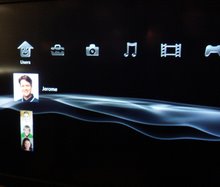
BroadQ partnered with CodeCodec to add advanced video codec support to the PS2. Till now CoreCodec have been a supplier of codecs and media players for cell phones. The partnership enables the PS2 to display YouTube video using the H.264 video format. The superior performance of CoreCodec’s codec enables decode of near HD quality video resolution. BroadQ will be demonstrating their QTV branded TV interface running on the PS2 at CES January 2009. Below are some early screen-shots of the QTV UI.


Note that these are not screen shots of the Flash version which BroadQ has previously shown during demonstrations. The images are from a new Lua Script implementation developed by Active-TV Technology for BroadQ. The Flash version required run-time PC assistance. This Lua version enables the PS2 to operate “standalone”, without any PC assistance being required. The UI implementation shown here is not complete; please expect changes before the CES showoff.


The application of the PS2 to view internet video from the living room TV is significant, given the greater than 120M units sold by Sony (see America Still Plays More Ps2 Than Xbox 360 and Wii Combined) . BroadQ plans for QTV, include support for video distributed by the emerging key suppliers such as YouTube, Hulu and more.
Daniel Mann

Wednesday, December 3, 2008

Now watch Google Video on the TV

Use Google Video to search for internet videos, then watch them at the TV, all without touching your PC or the keyboard.

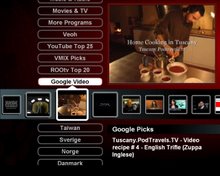
Google Video enables access to longer format video than typically available on YouTube. The YouTube channel (currently available for testing), has been extended to include searching for Google Video. A TV screen image is shown below.


The TV-web formatted channel can be used with the D-Link DSM520 or other active-TV technology-enabled TVs. Note: the TV remote 'info' key can be used to toggle 'on-off' auto-play, resulting in uninterrupted TV-like viewing of one video after another...

This latest update to the YouTube channel includes improvements to the IR remote text-input, a larger preview image, and the ability to temporarily switch User ID to that of the author of the current video. This last feature, along with switching User ID to that of friends and family, makes it possible to explore a network of ‘connected’ videos.


Additional changes and improvements will be made pending user feedback or other technical refinements.
Daniel Mann

Tuesday, November 18, 2008

New YouTube channel for DSM-520

Following recent changes in the way YouTube streams video, DSM-520 owners are reporting that they can no longer play YouTube videos.

Now there is a new YouTube TV-website for the DSM-520 which works with the latest YouTube video. A link to a 16x9 test version is provided here. This new channel is also available in the “TV-web channel” listings on the side of this page.

After downloading the YouTube_testing.zip file, extract all contents to the c:\ directory. The new “testing” channel will appear under TV menu “My Media & Programs”.


The new YouTube TV-web channel for the DSM-520 is completely different from any previous ones. It is fast loading and there is support for video search, Playlists, Subscriptions, Categories and Favorites (all of unlimited size). There is also flexible access to Standard video feeds. As an added feature, it is now simple to view any public videos of your YouTube friends. The 'info' key can be used to toggle on-off auto-pay of next video.

Please send feedback to daniel@active-TV.org, in the event further tweaks are required during the evaluation period. Or add comments to this blog entry.
(Note about prior versions: some bugs were reported by users, but all seems to be working with the current youtube_testing_2.zip version.)
Daniel Mann

Wednesday, August 27, 2008

x86 software for the living room TV

The Issue: Intel revealed more details at IDF about its TV chip based on an integrated x86 CPU, which lowers the barriers for networked TVs utilizing PC-like software

Behind the scene: I expect many high-end TV developers to closely consider the new Intel TV chip. Has any lack of clear leadership or innovation from the traditional TV chip suppliers left them vulnerable to market share loss? Or do they know something about the home TV user that new entrants have yet to grasp?

Solution: There are many competing technical and business approaches in support of digital convergence for the TV. Introducing a cost-effective Intel TV chip is clearly some kind of milestone. However, given Intel’s experience with Viiv, it should be aware that there are still critical and necessary development steps ahead: developing infrastructure, partners, and customers, and most importantly communicating the value to end users – these remain paramount and time-consuming steps to be undertaken.

Intel provided more information last week at the San Francisco Intel Developer Form (IDF) about their efforts to bring the software advantages of the x86 architecture to the living room TV. Prior approaches branded as ViiV had little success and partially relied on Microsoft Media Center technology. The new approach is very different and based on incorporating an x86 ‘Pentium M’ processor into a TV System-on-a Chip (SoC).

The x86 CPU architecture has a software advantage because of its use in the PC. This has lead to a long history of extensive and complex software being developed for the PC, which is frequently not made available (“re-targeted” as the technical types say…) for other CPU architectures. A good example of this is Adobe’s Flash, that essential plug-in to the PC browser. For non x86 CPU-based devices, Flash is either not available or available several generations removed from the current offering.

As digital convergence proceeds, consumer appliances are required to support software applications, which have thus far been the domain of the PC. It has proven difficult for traditional TV SoC suppliers, who do not rely on an x86 CPU core, to develop software to enable a TV to perform PC-like tasks, such as web browsing.

Intel documentation provides a block diagram of their CE3100 TV SoC family. Coupled with “aggressive” pricing, Intel is on course to have a significant influence on the initially high-end TV and Set Top Box (STB) markets. Using the CE3100 family, devices such as the Apple TV, which currently uses a PC-like architecture, can carry a lower hardware component cost. In fact, the CE3100’s support for processing a broadcast digital Transport Stream (TS) enables support for features currently beyond Apple TV.


As well as building a new range of TV chips, Intel will provide much of the software infrastructure supporting a CE3100-based networked TV. For this, they have to combine networking and web processing software with traditional TV software (what the engineers call dual software stack operation). Intel press releases indicate that they have worked with Futarque on this task. Interestingly, Futarque also collaborated with AMD on active-TV technology STBs.

No matter how enthusiastic technologists and business analysts are about the potential of TV convergence, it s is not clear how much technology the TV user really wants. Maybe a 3D UI with Flash animation is not desired by many? Maybe something much simpler, such as the very successful MHEG5 deployment in Europe, will continue to satisfy most TV users? That said, MHEG5 may not be left behind: there are companies working to add Ethernet and social network support for simpler MHEG5 TVs. If the CE3100-derived TV remains open (like the PC browser, for example) then it will gain the attention of many software developers, who will experiment and find hybrid software combinations that meet with TV user approval. However, if TV OEMs close their TVs -- like the Apple TV -- to “monetize” all convergence features, then the uptake will be much slower.

Increasingly, efforts such as MHP, OCAP or tru2way appear dated before they even have their day-of-success in the market. Their inability to deliver acceptable software solutions has left the market open to the CE3100, which draws upon software with a proven PC history.

Both the Intel Viiv and AMD Live!-branded projects, promoted as supporting digital convergence, met with little success. Interestingly, as Intel finds a new way forward via an x86 based TV SoC, AMD announces it will sell to Broadcom the TV SoC business it acquired with the ATI merger. AMD’s analysis of digital convergence would appear quite different from Intel’s

Technically Speaking
Requests by the networked TV to access an Internet webpage or widget are sent to the home router; and then on via the router’s broadband connection to the webpage or widget server. A TV must process the webpage or widget when it arrives. This requires complex software, which has traditionally been incorporated into the PC’s browser. A TV based on the Intel CE3100 has an advantage when stepping-up to perform these complex software tasks.

The active-TV technology approach relies on the router handing off much of the software task to a proxy in the form of a networked home PC: It enables a TV SoC not equipped with an x86 processor to access a PC’s software processing advantage. The TV’s request is first processed by the PC assisting the TV, and then simplified data is sent by the PC proxy to the TV for display. Some TV developers may prefer this approach as it reduces the prospect of TV obsolesce. The TV “borrows” the PC’s browser in support of its Internet access. This reduces the task of maintaining the TV’s browser software. TV purchasers expect a 10 or greater-year lifespan from their TV, as they would like to avoid the 3 year replacement cycle of traditional PC ownership. Conversely, TV manufacturers likely feel differently and would like to shorten this lifecycle.

More than Networking
Pioneer, Sharp, Samsung, Panasonic and others have introduced TVs with network support. Sometimes they are described as DLNA- or UPnP-enabled TVs. These TVs can access photos, music or video stored on a PC, which are also connected to the home network. Partly due to lack of simplified standards, these TVs are often poorly equipped to access Internet broadcast video directly.

Using an approach similar to active-TV technology, these TVs can use PC assistance to gain access to Internet video. MediaMall, a supplier of active- TV technology components, has announced a Beta version of its PlayOn software. This software runs on a PC that then acts as a proxy for the TV trying to access broadband-delivered video. Typically, a PC is used to access video from Hulu, YouTube or the like. But by using PlayOn, a PC can forward the video to any TV within the home network. The PlayOn software greatly extends the usefulness of a “simple” networked TV. A user can completely control video search and viewing using the TV IR remote, without requiring any contact with the PC assisting the TV.

Active-TV technology is more advanced than PlayOn, as it enables the PC to serve as a proxy for the TV accessing TV-formatted web pages that likely contain Adobe Flash. However, using active-TV technology requires a TV with middleware support beyond DLNA-UPnP. The simpler PlayOn software works with existing DLNA or UPnP-enabled TVs. Similar DLNA-TV supporting software from TVersity has been widely used for much the same task (2 Million downloads). TVersity is currently a more mature product, with reviewers indicating that, “at the moment PlayOn’s list of supported devices is much smaller than TVersity’s”. However, PlayOn is at the Beta-release stage. Their initial support for only online services indicates a focus on premium video services (such as Hulu), versus local PC-stored media.

Don’t forget the game platforms
For some time now, game platforms such as the Xbox, Playsation and Wii have included network support. This has enabled them to offer limited access to Internet broadcast video. Powerful as these game platforms are, they are not equipped to access the Internet with a browser as up-to-date as those used by the PC. This restricts their use for TV-web browsing.

Interestingly, in an effort to extend its audience reach, the BBC recently introduced a website tailored for the limited Wii browser. This enables access to BBC’s iPlayer catch-up video service. But to deal with current Wii limitations, the BBC must serve-up the video in the older Flash 7 video format, rather than the more efficient H.264.

We can expect to see versions of TVesity and PlayOn which further extend the types and variety of game platforms able to access video. These will no doubt rely on a PC assisted approach. Unlike the BBC, the PlayOn team can’t change the format of the served-up video, but they can use a PC to massage the video into a format digestible by simpler devices. The PlayOn website already indicates there will shortly be an enhanced version of PlayOn for the Wii.

Also relating to game platform developments, BroadQ had been working on PC-assisted software for the Playstation 2 (PS2). Recent developments indicate they have shifted to a method wherein the PS2 can access Internet video directly over a network connection – no PC assistance is required. BroadQ’s PS2 software is developed in Lua , much like some Sony PSP applications. Reports indicate the Qtv-branded software can directly play Internet video in FLV, H.264 and DivX formats. To simplify the Qtv PS2 software, the system relies on an Internet-accessed BroadQ server. This should prove interesting competition to the Wii when used to similarly access internet broadcast video.

What next
There are other platforms that avoid using networked PC-assistance, by supporting only simplified browsing -- such as the Syabas Digital Media Player box. Their DMP (also know as the Popcorn Hour A-100) supports most of the CE-HMTL format. Several sites are available for use with the DMP. The sites are accessed via a Media Service Portal (MSP). Maybe it would be better to call them portal plug-ins rather than websites.

Observers of digital convergence can only be impressed by the relentless efforts applied to bring Internet technology or interactivity to the TV. The CE3100 TV SoC is Intel’s best effort yet to make the x86 CPU architecture affordable for deployment within new TVs. On the one hand, it leverages a software installed base that includes support for Adobe Flash and other vital video entertainment software building blocks; on the other, it requires a new set of tools (and perhaps complexity) traditional TV manufacturers are not familiar with, as well as somewhat higher initial costs and perhaps the risk that consumers are not ready to embrace ‘full-on’ Internet-broadcast TV. Moreover, it is not the only technology or approach available, and some of the incremental approaches (with or without ‘borrowing’ PC browser assistance), may be just as valid, at least in the short term.

We will have to wait and see how the roll-out of the CE3100 TV SoC affects the evolution of the TV convergence market. To be sure, there will be business pressures to use it in only closed system. In view of competing and perhaps equally compelling approaches, however, I suggest Intel will gain the most traction in the market if it offers an ‘open’ platform for any software developer wishing to reach the TV screen.

Feedback, corrections and comments welcome. Contact me for more information or support with active-TV technology development.
Daniel Mann


Monday, July 7, 2008

Google to support the living room TV

The Issue: Google and others want a role to play in support of the living room TV. But how are TVs developing such that Google can have a role.

Behind the scene: Most if not all TV manufacturers are developing models with network support. These UPnP TVs enable media to be transferred between the TV and other networked PCs, appliances and servers.

Solution: The likely next-step after adding UPnP networking is for TVs to support browsing of TV-formatted websites. The life expectancy of a TV is long. This is why a TV may have Ethernet built-in but wireless networking technology, which changes more frequently, is likely left to an external add-on. Will browser technology be built-in or will it be left to as an external support role.

Efforts to get the PC and TV to work together continue. There is a desire to have PCs, TVs and hand-held devices, cooperate with each other. But as reported by the Wharton Business School, it is proving difficult to develop solutions which gain broad market acceptance.

One solution which has emerged with broad acceptance is the inclusion of Universal Pug and Play, UPnP, in new networked TVs. Further evidence of this is Google’s recent announcement of a PC UPnP server – Google Media Server. As mentioned in the NYT, a key point in their announcement is: “Google can offer a hardware maker a very easy way to add Internet video capability to a television”.

The last100 blog reports the Google server “works in conjunction with Google’s desktop search application - Google Desktop - to locate various media (photos, music and video) stored on your PC and make it available for streaming over a home network to any UPnP compatible or DLNA ‘certified’ device, such as a PlayStation 3” or TV.

There are already plenty of PC UPnP servers available, so why is Google entering the game? The Google PC sever can process information about media - know as metadata - in interesting ways. This can remove the TV from the burden of organizing media. A PC user can search and arrange media which is later enjoyed at the TV.

The information provided by the Google UPnP server need not relate to only PC-stored media, but also include information about web-accessible media. Perhaps the PC server is only a piece of the Google plan. A TV accessing web-video could be assisted by the PC’s UPnP sever, and make use of the media information organized at the PC.

A TV connecting with a Google server via broadband to the home can use the existing YouTube video library API to access video directly via the TV’s internet connection. Of course a broadband connected TV could also access some other video severs’ video resource. If Google extended its API it could upload meta-data from the PC sever to a Google web-sever. A broadband connected TV could then make access to the media meta-data without requiring networked PC assistance.

In all cases, the UPnP TV User Interface (UI) is determined by local TV firmware and not sent over the network connection. The media may be sent to the TV over the network, but it is up to each TV manufacturer to decide how to present the media on the TV screen. A UPnP TV is a step forward but it is not equipping a TV with the browser capability of a PC; where PC-webpages are sent over the network and used to format the PC display. So what is the next step for the UPnP TV?

It is clear that TV owners want some things built-into their TV and some things left out. They don’t want a VCR built-in, they don’t want a DVD player built-in, they do want a digital broadcast tuner built-in. With next generation TVs, customers want home network support, including UPnP access to media held on a PC.

TV purchasers want to also view video and photos delivered over the web; But it is not clear if the web browser and its plug-ins should be built into the TV or supported by an external box of some kind. Maybe TVs will be built both ways. One clear option is to use an existing networked PC as the “external box” supplying the TV with browser support.

Internet video broadcasters and TV-website developers, should be required to build a single TV-oriented TV-website which works with, both, a TV using a built-in browser, or a TV using an external browser. In the same way a VCR tape works with a built-in player or external tape player.

Flash is the most widely used browser plug-in. It seems essential that a browser built into the TV must support Flash. However, embedded browser developers are still finding it hard to integrated Flash into a TV-sized browser. (Apple TV has the internals and cost structure of a PC, not a low-cost TV chip.) Until this task is accomplished, it is much easier to use active-TV technology to support the TV with an external browser which does have Flash support. In fact for some TV purchasers may continue to prefer this approach. We don’t yet know.

The recent Adobe announcement regarding removing licensing fees when embedding Flash into non-PC video play-back devices, will help ensure Flash as the next “standard” beyond UPnP. TVs and STBs using Flash and AJAX (web 2.0 technology) can accomplish much more than a TV only utilizing UPnP.

Feedback, corrections and comments welcome. Please Contact me for more information or support with active-TV technology development.
Daniel Mann

Tuesday, May 6, 2008

BBC News channel restored, via RTMP support

The Issue: Web and internet technology are always advancing. PC users are familiar with getting software updates enabling support for the latest and greatest features. TV-website support for BBC News video was recently interrupted due to a BBC technology upgrade; but now service has been restored following some rapid PC-side software improvements.

Behind the scene: A TV intended to support internet video browsing must deal with the continual change in internet video broadcasting technology. This is much more difficult to achieve using low-cost embedded microprocessor technology than a PC. This leads to the temptation to tie a networked TV to a managed portal service. But who wants a TV than can’t ‘tune’ to any internet broadcaster’s ‘channel’.

Solution: Active-TV technology pushes the burden of supporting software complexity from the TV to the networked PC assisting the TV. This simplifies the task of keeping a networked TV updated with the latest features being used by an internet broadcaster. Importantly, this ensures a long and useful life for the networked TV.

There are several free-to-download TV-websites available at this blog. One of the most popular has been the BBC News channel. Recently and unexpectedly the BBC channel stopped working. This was a result of technical changes at the BBC. I am pleased to report that a new TV-website has been developed and living room TV access to the BBC video has been restored.

The BBC maintains RSS video feeds for access by internet users. The RSS information is in XML format and contains links to individual videos. After examining the XML document, the TV-website software selects an individual video and a request for transportation over the internet is sent to the BBC. Until recently, the BBC was ‘sending’ the video via a protocol known as HTTP, but now they are using Adobe’s RTMP protocol.

A number of other internet video broadcasters are also using RTMP, notably Hulu. Active-TV technology collaborator MediaMall has been working on a new Hulu TV-website – it was mentioned on their blog. To enable access to Hulu video (and other RTMP streaming) they constructed a software module supporting RTMP. Recently they have been offering this optional module to TV and Set-Top Box developers.

Networked TV and STB developers have been relying on UPnP communication stackware from a verity of suppliers. MediaMall has not been one of these suppliers. This was the case with D-Link, but in support of Hulu video, D-link will be incorporating MediaMall’s RTMP extensions into their PC-side software. (The RTMP video is translated into the familiar HTTP before being sent over the network to the DSM-520). This will be included in a larger software update soon to be issued for the D-Link DSM-520.

I have tested my new TV-website using an early version of the new software bundle. The TV-website makes HTTP formatted requests for RSS data, and RTMP formatted requests for individual videos. D-link undertakes their own testing and will release a version of the updated PC-side software from their PC-website. Those who feel they can’t wait can download the current beta version.

Feedback, corrections and comments welcome. Contact me for more information or support with active-TV technology development.
Daniel Mann