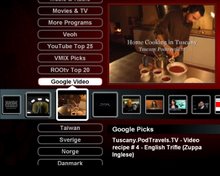
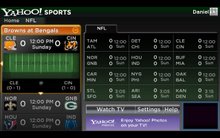
Active-TV Technology for iPhone and iPod touch

Active-TV Technology for iPhone and iPod touch
Navigate YouTube

Navigate YouTube available at iTunes App Sore

An easy to use iPhone and iPod touch App that enables both new and advanced YouTube users to get the best from YouTube.

Browse video Standard Feeds, Categories, Channels and Playlists. Then organize new videos into your own favorites and playlists. Make playlists private or public. Subscribe to other user's playlists and video collections for future viewing. Subscribe to videos matching search-words.

Look at publicly viewable favorite videos, playlists and subscriptions based on your YouTube friends, family and contacts. Send and receive video links with YouTube contacts via YouTube video messages.

Search for new videos tagged for your language or geographical region, using local keyboard. Explore for new videos via easy switching of user ID to the owner of interesting videos - then explore their world.

All actions are kept in sync with PC, Mac or Apple-TV access to YouTube. Available at Apple App Store.

active-TV technology for PC

active-TV technology for PC
Windows PC based home network

Monday, January 28, 2008

Complete torrent control from living room TV

The Issue: Outspoken industry experts report that internet-delivered video to the living room TV is in desperate need of platforms which are open, low-cost and conform to a standard. Are such platforms technically possible? And who are the winners and losers if such an objective was achieved?

Solutions: Dominance in the delivery of video and advertising to a living room TV audience is such a great price, that many are reluctant to collaborate for fear of reducing their share of such a prize. As well as an uncooperative business environment, there are software-complexities and hardware-cost obstacles that prevent the emergence of open-platform solutions.

Behind the scene: The PC, with its browser support, has set a standard for open PC-web development. Using networked PC-assistance, the existing and open software infrastructure can continue to support open access to TV-web. Via technologies such as active-TV, a TV can be free to openly browse TV-websites, including those with supporting the latest Web 2.0 features. This is achieved while adding minimal cost to the TV and without burdening it with maintenance or feature-longevity complexities. Moreover, this approach produces a much more interesting experience for users than more expensive and un-assisted TVs, which have less Web 2.0 support and are tied to business deals involving limited video portal access.

An industry problem ?
No doubt you have been following recent announcements from Samsung, Panasonic, Sharp,and likely others, that they will add access to internet video on new networked TVs – sometime in the first half of 2008. Many reporters are now saying 2008 will be the year in which Internet-delivered video reaches a large living room TV audience.

The technical approach by and large involves integrating support software to enable the TV to access a video supplier’s portal or tailored RSS feeds. This portal styled approach, however, does not enable the TV to access any video feed or even easily keep pace with the rapid changes in web technology. Maybe these TV suppliers are hoping customers will just buy another TV when they all too quickly discover that the features supported by their TV's integrated software are increasingly inferior to next month’s model...

The problem of building a STB or TV capable of dealing with all Internet video sources and variants was recently discussed by Amino’s marketing VP (the number one supplier in IPTV boxes): “... Simply offering our boxes in retail wouldn't work: there's just not enough consistency and standardization out there to make doing that a proposition that would be satisfying to consumers”. Note that the lack of standardization is not a problem for the PC, which has the support software to deal with it; it is a problem for a low-cost, low-maintenance and longer-life TV.

Jeremy Allaire and Adam Berrey of Brightcove, have published an open letter to the CE industry requesting a joint effort to bring standards to internet TV appliances. The letter states: “An even greater limitation than complexity is the fact that today's strategies are fundamentally closed”. They go on to say:

Each device has a different set of standards and requirements for using online video content, so there is no consistency of formats and user experience.
Most devices don't provide open access to any video service that is hosted on the open Web, and instead require direct deals and relationships with the device vendor.
Related to the above, none of these devices offer a simple and open development model for web service developers to create and deliver custom content and services.

Unlike the PC-based web and the mobile-web, which are both built on open standards, the consumer electronics ecosystem offers no consistent set of open standards for online media to reach televisions. [end quote]

The letter proposes some very good solutions, such as standardizing on an XML format for video RSS feeds. But without a dominant TV hardware platform leading the way via an all-pervasive application software standard, there is no coordinated effort to date to build a TV software infrastructure conforming to a single standard.

Consequently, likely accompanying each of the new networked TVs or networked Set-Top Boxes (STB) is a Software Development Kit (SDK), which application developers would have to use to build video portal interfaces or screen widgets. Given the endless possibilities for variants, this is likely to add 'SDK fatigue' to the growing DMA fatigue.

CE developers don’t feel equipped to take on an effort to drive some kind of Web 2.0 technology standard for the TV. The task is difficult, to be sure. Comparable projects from Microsoft, Intel Viiv and AMD Live!, have all met with failure. There are also large differences in the capabilities of TV Systems-on-a-Chip (SoC) used in the CE industry. It would certainly be possible to build a standard around something like Apple TV, given that it is basically a headless PC without the problems of the Windows operating system. However, a $15 TV SoC cannot replicate the software support of an Apple TV. If this were possible, the market would be awash with $15 integrated-PC browser systems. I could suggest that the home PC user would greatly appreciate such a device, but the PC industry is not yet capable not interested in supplying such a solution.

Maybe the networked TV buyer must factor in a low-end, PC-like cost adder to their TV purchase or be content with the meager video offerings and low-end features available in first-generation networked TVs? Buyer’s enthusiasm for adding, say, $250 to a TV appears weak. Hence, the recent Apple TV price reduction from $299 to $230. Sharp has suggested it will charge $200 more for its networked TV models, which have limited portal support. Maybe Apple will offer Apple TV integrated into a TV, once it clears unsold Apple TVs. This may motivate an industry response, but it is not the establishment of a standard...

The Brigtcove letter states that “closed” is a greater limitation than “complexity”. I think “complexity” refers to system configuration and maintenance rather than cost. I am not sure I agree with this part of an otherwise excellent letter. The PC-in the living room was an open solution, but more significant to its downfall than 'too-much-noise' or 'too-much-cost', was 'too-much-maintenance support'!

Web 2.0 technology for PC-web continues to develop rapidly, with new 'must-have' features continually emerging. We should expect web 2.0 support for the TV to show a similar development pattern. It is hard enough, maybe impossible. for the CE industry to standardize on a reduced set of Web 2.0 features, all supported by a $15 TV SoC today; it would be even more difficult to keep pace with PC-web 2.0 developments, without the added hassle of TV maintenance and compatibility problems.

I think an unalterable requirement for TV buyers is reliability and 'zero TV maintenance'. New TV buyers might be prepared to reconfigure their file sever or home network router, once; but they are not willing to maintain TV plug-ins and drivers. It would remind them too much of their Windows PC. They may have accepted the maintenance cost of PC-web access, but they don’t want to double this burden by adding similar PC-like TV maintenance.

I submit that active-TV technology frees a TV from dealing with the lack of simple Internet-video and Web 2.0 standards. Via PC-assistance, a networked TV presents web pages formatted for the TV. These TV-web pages (or channels) are easy to build and can come from a great many sources. The system is flexible, easily upgradeable, maintains TV reliability, is universally accessible and keeps the TV-side costs down. By maintaining a PC’s access to TV-web, a networked TV user can utilize this cost-effective resource to support browsing of TV-web.

A networked TV connects to the internet via a home router or gateway. A home PC also connects to the internet via the same router. Active-TV technology requires a PC be left in standby mode, in case it receives a request from the TV, via the home router, for temporary assistance in processing Web 2.0 software. The energy costs of keeping the PC in standby mode are less than the energy costs of a large plasma or LCD TV. Anyway, the PC may be simultaneously and invisibly used by another person who is also accessing TV-web or PC-web pages or channels.

Internet Video Broadcaster support
DivX officially launched its active-TV technology-styled “DivX-Connected" DMA at CES 2008, having first seen demand for this product in Europe. With the goal of continuing to expanding support beyond Stage6, DivX announced that they will add video from the popular Internet Broadcaster Veoh. Not surprisingly, there is already an active-TV technology supported TV-web channel for Veoh (see below).

Clearly, Veoh is showing enthusiasm for reaching the living room TV on platforms other than the living room PC. However, if TV manufacturers continue along a 'please-use-my-SDK path', then a video broadcaster’s ability to reach a living room audience will be constrained. This may result in a shake-out of internet video broadcasters.


As internet video providers are under pressure to make money from PC-web or TV access, the greater freedom of PC-web access may not be easily translated to TV access. For example, YouTube may allow free access to its PC-website, but it may become more restrictive in granting a standalone-TV access to its video. YouTube and other Internet broadcasters may prefer a TV portal to an open TV-website. This would enable them to better control deals with TV builders and advertisers, and monetize their video on TV. If this is the case, the industry would not be driven in the 'open' direction proposed in the Brightcove letter; instead, the establishment of open TV-web browsing -- similar to PC-web browsing -- using technology such as active-TV, would be delayed.

It is easy to build a TV-website or channel using familiar PC-web browser technology: HTML, Javascript and Flash. Below is an example: a TV image of a TV-web channel for videos available through Internet video broadcaster, ROO. The video menu shows three options: “World News”, “Travel Europe” and “Entertainment News”. These are selected from the ROO “setting”s page, which offers about 170 menu choices. The video, like Veoh video, is of a much higher visual quality than YouTube video.


The advocates of a standalone TV approach, that is a TV operating without any PC assistance, do not expect the TV to replace all PC-web functions. They don’t expect triple-tap entry via the TV remote to be used to search for and organize all video. Everyone agrees that this is still a job for the PC. This is similar to managing an Apple iPod from its iTunes PC or Mac interface.

Networked TVs will also have to solve the problem of filtering video for ‘family’ viewing. Many parents will not allow their kids to use a networked TV to freely search and access video from YouTube. It is easier to define video search criteria, manage video playlists, and control video filtering from the PC than a simpler networked TV. This better enables the user to enjoy the relevant video at the TV without continual interruption and excessive TV interactivity.

I think portal restrictions, lack of open internet-video access, and failure to keep up with the latest Web 2.0 technology experienced on the PC, will prevent first generation stand-alone networked TVs from widespread adoption.

TV access to shared photos
Several of the networked TV announcements indicated they would have support for internet photo sharing. One such popular site is Google’s Picasa. A prototype TV-web channel for Picasa has already been built. There is a menu button which enables photos to be viewed full-screen in a slideshow sequence. The familiarity and productivity of TV-web or TV-web development tools greatly simplify this kind of development. It will be hard to for an array of TV SDK users to keep pace with TV-web development.


For those less familiar with Picasa, the PC-website below is used to upload photos for sharing with other web users.


Using the menu-settings page of the Picasa TV-web channel (see below), a photo album can be selected. A user must first enter a Picasa User ID (this is stored for future use). Photos can be viewed individually, or as a slide show. This is a great way for a PC user to “send” photos for someone else to view on their internet connected TV.


Torrenting from the TV
Another industry leader, the BBC’s Ashley Highfield, has also been blogging about the lack of industry standards. Like Brightcove he is hoping for “a simple, elegant, cheap, open standards box, that easily allows streamed or downloaded, free, rented, or bought programmes”. Importantly, the “cheap” requirement has not been overlooked.

Maybe the networked TV user does not need the Web 2.0 features of PC-web. If this is the case, then when the business conflicts are finally resolved, the industry can provide a cheap solution. Maybe TV users will step-up to paying the additional cost of Apple TV-like hardware. However, there has been strong evidence indicating that they are not yet ready for this expense. If Web 2.0 is required at the TV, then the problems of unwanted hardware cost, too much TV maintenance and networked-TV feature-longevity, are all resolved by using a PC-assisted approach.


The Highfield blog goes on to say, “mentioning this to a very tech savvy colleague this morning, he replied that he downloaded programmes through BBC iPlayer [on a PC], stripped the DRM (hence his anonymity!), re-encoded the file, burned it to DVD from his PC, then took it to his DVD player connected to his TV in the lounge. Hardly a solution for my mum either.”

It is quite easy for active-TV technology to greatly simply the practical steps being taken by Ashley’s “tech savvy colleague”. No doubt there are a great many PC-web users who torrent (peer-to-peer transfer) video to their home PC. This video is typically provided in MPEG4 variants such as DivX. If the user does not own a MPEG-4 enabled DVD player, they mostly transcode the video to MPEG-2 format for playing on a ‘normal’ DVD player. The whole process of going to the PC to initiate a torrent (P2P), transcoding the video, writing a disc and 'sneaker-netting' it to the living room DVD player can be replaced by a simple TV-web site which supports torrents.

I have built support for the popular uTorrent engine into a demonstration TV-web channel. Now using only the IR remote of an active-TV enabled TV or STB, such as the D-Link DSM520, I can control all the necessary steps from the TV, without ever visiting the PC.

For demonstration, I added support for video torrents offered by http://www.democracynow.org/ and http://www.bittorrent.com/. The torrents are provided by RSS feeds. BitTorrent has feeds for “TV” or “Movies”. This explains the “TV” entry in the menu entry below. Selecting the “Amy Goodman” menu entry, enables selection of “Democracy Now” news and analysis programs.


By simply clicking on the “Willie Nelson” menu entry at the TV, the networked PC-assisted TV will start the associated torrent.


Using the “active torrents” menu entry, it is possible to manage torrents and monitor their progress. Not shown are additional menu entries for pausing, restarting and removing completed torrents. As torrents progress, their percentage-completion is reported. Below is a snap-shot of a torrent for the 'Democracy Now' show from January 23. When “100% download'” is reached, the show is available for viewing. The “share ratio” refers to the torrents upload-to-download ration. Naturally, it is possible to have several torrents running at the same time and at different stages of completion.


So there we have complete torrent access by a living room TV, without ever visiting the PC or having a PC attached to the TV. There is no need to write an intermediate DVD. This is accomplished without adding complexity and cost to the TV as it relies on networked PC assistance. Conveniently, if a torrent is alternatively started from the PC via PC-web selection, it is still reported and monitored on the TV-web page. Interestingly, the '”Democracy Now” video is in H.264. The D-link DSM-520 supports DivX but does not natively support H.264; however, the PC invisibly transcodes the video before sending it to the TV for viewing. Another benefit of PC-assist,

Feedback, corrections and comments welcome. Contact me for more information or support with active-TV technology development.
Daniel Mann

Wednesday, January 2, 2008

Getting the most from YouTube video at the living room TV

The Issue: The YouTube PC-web site is a very popular video share site. In its present state, however, given that it is formatted for viewing on the PC, YouTube videos cannot be conveniently accessed from a living room TV.

Solutions: Active-TV technology overcomes this limitation and enables YouTube video to be easily viewed on any TV around the home. YouTube video is accessed via TV-web format rather than a PC-web formatted page.

Behind the scene: The TV-web site described below does not replicate all of the search features of the YouTube PC-web site; rather, the two sites work in tandem: The PC-web site features are used to ‘prepare’ video channels, which are then immediately available for easy viewing at the TV.

Below is an image of a TV-web site for YouTube video. The menu in the upper-right enables selection of 1-of-3 video channels, either pre-existing or easily created by individual users of YouTube. Currently, the “Flintstones” channel is selected. The second menu, in the lower portion of the screen image, is used to select individual videos from the selected channel.


The above TV-web site does not support searching for videos or arranging them into channels. No big deal, as this is easily done on the existing YouTube PC-web site. Consequently, the PC-web site and the TV-web site work together to give complete control over viewing video on the living room TV. The TV-web site has the advantage of being organized around the “lean-back experience” and group-viewing. Additionally, it is easy to simultaneously use a notebook computer in the living room to organize YouTube videos into channels, and then immediately view them on a corresponding TV-web site.

There is an added security advantage when eliminating support for random video searches at the TV-web channel: parents can pre-approve videos or video sources for all channels made available to children at the TV.

Before looking at how TV-web channels are selected, let’s first review some of the basics of YouTube access. YouTube members can upload videos for sharing and future review. Each member can arrange their uploaded videos into a YouTube Channel, or several Channels. In fact, a Channel can be constructed from other users’ uploaded videos as well. A members’ Channel is available for other YouTube users to view.

After logging into the YouTube PC-web site, a user can select the corresponding tab to either Videos or Channels. It is easy to search for new videos by selecting the “Videos” tab [shown below] and entering a search-string in the Search Box.

When a new video is found, it can be played in the familiar YouTube PC-web player. At the bottom of the player [shown below] are options to add the video to “Favorites” or to a “Playlists”. Unlike video favorites, the use of playlists enables saved videos to be grouped appropriately.


When a playlist is initially created (via the “[New Playlist]” option when using “Add to Playlists”) a title for the playlist must be entered. Also, the playlist must be marked “Public” or “Private” [as shown below]. If a playlist is Public, then other YouTube members can access the playlist without having to enter a password for the member who created the playlist.


An easy way of accessing Favorites and Playlists is by clicking on the hyper-linked user-ID at the top of the page. When I click on “daniel78746” at the top of my YouTube page and then select the “Playlists” tab, I can access all of my saved playlists.


By using the “Edit Playlists” button, I can make changes to my playlists; such as changing the order in which each video plays. There are other ways of navigating to the same “My Account / Playlists” page.


Remember, it was stated earlier that each member can have YouTube Channels. The “Channel” tab at the top of the initial YouTube page is used to list channels. After selecting a channel, such as the 'National Geographic' one, it is possible to subscribe to the channel. As shown below, there are currently only 26,918 subscribers to the National Geographic, a fraction of total YouTube viewership. [The low numbers of channel subscribers makes me think that YouTube channel subscription is an under used resource by its members.]


When a video is viewed in the player window, there is often an option to the right of the player to 'Subscribe' to the channel in which the video is contained. There are different ways to review the channels currently subscribed to, i.e. “My Subscriptions”. First, via the “Home” tab on the initial page, followed by the “My Subscriptions” link; Secondly, via the user-ID at the top of the initial page followed by the “Subscriptions” link. Once there, there is a button to “Edit Subscriptions”.


Note above, the box to the right which enables subscription to “Tags”. This is a bit like creating a channel from video search criteria. For this example, I have entered “wallace and gromit”. After creating this subscription, I have a collection of relevant videos, which YouTube gives the ‘channel name’ “gromit wallace”. This alphabetical reordering can be prevented by literally using a quote symbol ( “ ) in the 'Subscribe to Tags' box, but the “and” will still ‘disappear’.

Returning to the TV-web page at the start of this article, the menu has a “Settings” option and when this is clicked using the TV’s IR remote, the “settings page” shown below appears.


Each of the 3 video menus has separate controls which are used to select the video included in the channel. In the example above, menu-1 is set to Videos -> Flintstones. Menu-3 is set to Playlists -> Old Grey. Each menu setting requires a first and second choice. The left, or first choice, can be varied between: Videos, Favorites, Playlists, Channels, and Subscriptions. The right, or second choice, is used to further narrow the selection.

YouTube also provides several video groupings know as Standard Feeds and Categories, such as: Most Viewed, Top Rated, Featured, Sports… These are made available under the Videos selection. Note, merely for convenience and demonstration, I have added some more video groupings, such as the Flintstones.

Under the Channel selection, there are several popular YouTube channels, such as National Geographic, NHLVideo and Motorstelevision. These channels are available without requiring subscription to the channel.

Remember the above example of subscribing to Video Tags “wallace and gromit”? Well, the ‘channel’ created now appears under the Subscriptions selection.


Selecting Subscriptions -> gromit-wallace for menu-2, as shown above, results in a listing of relevant videos appearing in the menu - after using the TV IR remote and the Return-To-Video-Menu button. Parents should note that using “Subscribe to Tags” does not always ensure appropriate video for a younger audience. (For example, the term 'Bambi' could return videos relating either to the Disney children's story or to an 'adult' entertainer...) It is more secure to use tag-searching to create a list which must be reviewed and further reduced to a Playlist. For some audiences it may be safe to rely on videos from certain channel sources, such as National Geographic.


Selecting Subscriptions, Playlists and Favorites requires the use of a YouTube member ID. The ID in use is shown at the bottom of the settings page [shown earlier]. There is a box for entering a new ID. Using a TV IR remote triple-tap sequence, the ID is entered. It is stored along with all the chosen settings in the form of TV-web cookies. This means, after turning on the TV and returning to the YouTube TV-web page, the previous channel settings are completely restored.

The user ID is sent to the YouTube server to enquire about the member's P and Subscriptions. No password is used and consequently only video items market 'Public' can be viewed. By entering another ID, say, someone else's member ID, it is possible to view their Favorites and Public Playlists.

Because a TV may be shared by several people and each may have their own channel preferences and user ID, the top-level menu can be used to select a TV web site from several YouTube TV-web icons; each leads to its own YouTube TV-web site as set up by an individual user. This reduces or almost eliminates the need for triple-tap at the TV, and allows different users to quickly switch between their channel preferences.


Note that the “YouTube Family” TV-web site only supports Favorites, Playlists and Subscriptions. Eliminating the Videos and Channel setting options, means a parent has greater control over what can be seen on the TV. Installing only the associated YouTube_family.mcl file ensure that the other YouTube TV-web channels do not reach the TV.

Feedback, corrections and comments welcome. Contact me for more information or support with active-TV technology development.
Daniel Mann

Thursday, December 20, 2007

PC pulls back from living room TV integration

The Issue: The notion of selling a PC attached to the TV in the living room was stillborn in the market some time ago. Intel has just now announced its passing, little surprise to anyone familiar with how most consumers really use these products. Given Intel’s announcement, is it now safe for the cautious reporter to write about what was an inevitable demise?

Solutions: No sense throwing the baby out with the bath water. Enthusiasm for Internet-based video viewable on TVs throughout the home remains undiminished, regardless of whether Intel puts a halt to promoting the living room PC. The only way forward is in combining what is best about the PC with what is best about the TV: The PC should serve as the software work horse engine for the TV, as required, while the TV benefits from remote access to Web 2.0 technologies & features without having to manage any of the complexity or grapple with unforeseen future technical obsolescence.

Behind the scene: With delusions of grandeur, PC-industry executives' ambition lay somewhere between unreasonably optimism and wanton incompetence in believing that a PC running a Windows operating system could bring a cost-effective and stable ‘experience’ when integrated into the TV. Their failed efforts, moreover, set back needlessly the adoption of thin-client technology and opportunities to bring to the living room the immersive software and web experience of the PC which is still found lacking on the TV.

PC companies like Intel, Microsoft and AMD have for several years now sought to promote sales of PCs connected to the TV in the living room. Brands such as Intel Viiv, Windows Media Center Edition (MCE) and AMD LIVE! remain associated with these efforts. Despite the look of a sleek DVD player, or the feel of a high-end home theater console, these PCs never met much consumer enthusiasm. Facing the inevitable, news reports indicate that Intel has now decided to, “Scale Back on Viiv Digital Living Room Branding”.

Central to this failed endeavor was the notion that placing a PC in the “critical path” of the content flow [i.e. routing the TV signal first through the PC] would somehow be mutually beneficial to both PC vendor and ‘content’ owner alike; whereas in reality it simply increased the risks without bringing much benefit. First, Intel was forced to “work with content companies to certify that movies and other video fare delivered over the Internet worked well with a remote control and looked good on a TV screen,” an endless and needless effort. Second, contrary to conventional, if flawed, reasoning [and as I have been pointing out for several years now], a PC is not really required to access video over the Internet. There are other options, all of them less expensive, and all of them producing less heat, noise, or maintenance issues associated with using a Windows operating system. These facts did not stop management, however, from supporting overly ambitions objectives regardless of the evidence to the contrary.

Also of note, the brands listed above where not only primarily focused on PCs attached to the TV but also confusingly associated with extended-PC plans -- but without explaining how these two approaches were separate. In the case of Intel, the extended-PC approach required use of a Viiv client or an MCE Extender box at the TV location, rather than a Viiv PC connected to the TV.

Apple did not make this mistake with the Apple-TV, which is a client of an Extended-PC or Extended-MAC. Apple has clearly indicated that the Apple-TV is the device to connect to the living room TV.

No doubt the decision to promote the PC-in-living-room by PC industry players was the result of both little experience in marketing consumer appliances and a failure to produce client devices that function well. Those sold to date were Digital Media Adapters (DMA), a device category not readily understood by consumers. Their associated marketing campaigns are now severally criticized by the press and analysts. And yet, Microsoft, undaunted, is about to launch its second generation of Extenders, with a price tag of nearly $350 each, which likely makes these offerings dead on arrival (DoA).

The strategies employed by Intel and AMD, including “Viiv client” and “AMD LIVE! Ready” branding campaigns, have never gotten off the ground, since having failed to recruit to the cause significant numbers of established consumer appliance manufacturers (largely due to onerous branding requirements and meaningless technical specifications), and having championed broadcast reception in the PC (required to keep the PC in the critical path of content flow), these branding programs have inevitably come afoul of consumers. These consumers have no appetite for the cost, attendant technical issues, and networking complexities. As a consequence, broadcast reception technology was never integrated with thin-client technology; and so we find ourselves with DMA client boxes rather than TVs integrated with network and thin-client support.

Compounding these problems, the PC industry has tied Internet video support to premium PC operating systems, in insisting that Windows Media Center rather than basic Windows XP (with its massive installed base) be the requirement to run a Media Center Extender device.

Since progress is never linear when it comes to technology adoption, at this stage in the Internet video development game, there is a market for low-cost DMAs such as the D-Link DSM-520. It is used by early adopters and supports existing TVs which naturally do not have integrated network support. Of course, the DMS-520 works with all widely used PC platforms. Early adopters can use them today to watch lots of varied Internet-delivered video, currently without much advertising support or any expense for content access (no cable TV bill). With this increasingly compelling experience, greater numbers of consumers are eventually going to realize what they are missing. . .

To this end, the alternative active-TV technology approach relies on an Extended-PC only to assist the networked TV or networked STB, when it is needed. Whenever the TV or STB encounter software complexity or require other support (i.e. access to home photos or video stored on the PC, video reformatting, complex UI features and the like), it can call on the PC. Most importantly, the PC is not in the critical path of content flow: A TV or STB client performs traditional TV tasks entirely alone, without PC assistance; in other words regardless of whether or not the PC is turned on or off.

The “complex software” which even the next generation of TV chips cannot support includes advanced UI features and Web 2.0 technology (e.g. mash-ups, widgets, RSS feeds, etc.) – which continues to advance in ways unforeseen, and for which the PC is supremely able to keep in stride. How to help the TV in the living room gain access to ‘the Web 2.0 experience’ remains the central question and has always been the only real task for the PC. In short, it is accomplished via the home network and without a PC connected directly to the TV. It follows that active-TV technology was developed precisely to accomplish this task, and this is why it has gained acceptance among the more traditional TV developers.

While moving away from the living-room-PC, the rumor mill reports that Intel is working on an x86- based TV chip, codenamed Kenmore, of which we are likely to hear more about at CES 2008 (January). Prior attempts to integrate x86 technology into a TV system-on-chip (SOC) have not been successful – but, to be sure, the attempts have been many. Intel nevertheless has made acquisitions to gain access to the necessary technology. It is not clear if the ‘first generation’ will be a multi-chip module. The chip is unlikely to be used with Windows, but will better enable Intel customers to offer standalone support for Web 2.0 technology in a TV. It might even be used in a future Apple TV. Suppliers of non x86-based TV SOCs can still offer complete support for Web 2.0 via active-TV technology integrated directly with their displays and in combination with assistance from a networked PC or laptop.

In conclusion, to some the unassisted “TV goes it alone” approach may appear to have advantages over the “TV with remote PC assistance” one. However, looked at more closely the differences in network support are likely irrelevant as all of these systems are going to be networked regardless of where they are located in the home. Any user of these systems almost certainly already maintains a PC and keeps the web access technology or applications up-to-date (i.e. Flash updates, Java plug-ins, browser add-ons, virus scans, etc.). Relying on PC assistance, therefore, removes the added burden of keeping not just the PC but also the TV software up-to-date. The PC, with its much shorter refresh cycle (2 - 3 years vs. 6 - 10 years for the TV) can always be upgraded in the future and consequently it (or the TVs it supports) will not likely run out of processing power. Lastly, there are likely cost and TV-technology advantages to a TV supplier by continuing to use low-cost and established TV chip suppliers.

Feedback, corrections and comments welcome. Contact me for more information or support with active-TV technology development.
Daniel Mann

Tuesday, November 27, 2007

Clearing the Fuzzy picture for Apple TV

The Issue: Regarding Internet video distribution, some reporters and analyst seem to be lagging behind actual marketing and engineering developments. They continue to suggest that open Internet-delivery of video to the living room TV has not yet been achieved, and is beset by insurmountable barriers.

Solutions: Current solutions do exist and mostly make use of DMAs, but these will soon be accompanied by the necessary technology integrated directly into TVs and hybrid-STBs. These solutions are open; that is, they are not tied to any particular video portal service.

Behind the scene: Active-TV technology enables TV developers to offer consumers an option to enjoy TV-web ‘browsing’. Today, anyone is free to build a TV-web formatted website or channel. TV-browsing (of TV-web channels) is freely available and as open as PC-browsing (of PC-web sites).

CNET’s Tom Krazit sees a “Fuzzy picture for Apple TV”. This comes at a time when there has been much speculation about an Apple TV ver. 2.0. The issues regarding how the Apple TV might develop next have been covered previously in this blog. The constraints remain the same, the choices include:


  • Exploiting the benefits of a new and hopefully lower cost chip from Intel.
  • Hiding the high-end DMA cost ‘behind-the-glass’ by integrating Apple TV into a TV.
  • Morphing the Apple TV into a box that consumers already understand, such as a STB or DVD player
  • Opening up Apple TV for other developers and marketers to exploit.

Ross Rubin of NPD is quoted in the CNET article saying: “the [DMA] category of devices is so nonexistent”. What he is fundamentally overlooking is that Internet delivery to the living room TV does not have to be via DMA or via closed system. Instead, it can be via a TV with integrated network support and in a manner that is completely open to all video distributors. Compounding these misperceptions is the way in which Krazit describes delivery of Internet to the living room TV as “a question that has eluded the PC industry for years”. I disagree with this: there are systems available at retail today that proof Krazit wrong (see: http://www.dlink.com/activetv/). Any failure may be in marketing the solution, not in making it technically feasible.

Responding to the CNET article, Steve O’Hear at the Last100 states “and yet it’s still difficult, if not impossible, to get content originating from most Internet TV services onto a television”. He goes on to say: “why has the AppleTV failed to ignite the market for PC to TV devices?” Two reasons are suggested: One is that Apple-TV uses PC-assistance to support its features. The second reason, which gets CNET support, is that Apple TV is a ‘closed system’, with its tight and exclusive ties to the pay-to-download iTunes Store.

Rather than being “impossible” to get Internet TV service to the living room TV, it is actually rather easy. Both Krazit and O’Hear are missing the important fact that DMAs and STB boxes are available today that support open distribution of video content. These are boxes supporting active-TV technology. Most of the Internet Video sites support an API or RSS video distribution. There is little engineering effort required to connect these to template TV-web channels. Future template developments will eliminate even these simple engineering steps. Active-TV technology is currently being integrated directly into TVs, which eliminates the little understood DMA.

Web pages formatted for the PC are not appropriate for living room viewing. This is because small text, pop-up menus and keyboard interactivity is unwanted in the living room. This does not create any great difficult for the web designer, they simply follow a new set of ‘guidelines’ which suit web pages built for the TV; Know as TV-web, interactivity is via the TV IR remote.

As Apple and others have discovered, there are overwhelming reasons why the TV is best not burdened with any direct integration of the technology required to support web 2.0. The optimal solution is networked PC assistance. After all, what web 2.0 user does not already have a networked PC?

Also missed by Krazit and O’Hear, is the ability of active-TV technology TVs to support ‘open browsing’ of TV-web formatted sites. There are a lot of interesting sites already available. Anyone is free to build a TV-web site -- there are even templates available. Moreover, active-TV technology enables all these sites to be delivered to the living room TV. Today, it is not difficult to build a TV-web version of any of the popular PC-web based Internet video sites. It is quite easy to connect their RSS feeds into available TV-web template pages.

Whatever so called “barriers” remain to Internet-delivery of video to the living room TV, they are not primarily technical, limited to exclusive content, or downright unavailable. Reporters should catch-up with this fact and better serve their readers.

Feedback, corrections and comments welcome. Contact me for more information or support with active-TV technology development.
Daniel Mann

Monday, November 12, 2007

Living room TV advertising support for TV-web channels

The Issue: The ease with which Internet-delivered video can now reach the living room TV is certain to lead to renewed interest in new forms of advertising, assuming they complement, rather than detract, from TV-web viewing.

Solutions: Since Active-TV technology supports Web 2.0 technology, this allows PC-web based advertising techniques to be reapplied to TV-web channels.

Behind the scene: Click-to-view video advertising for TV-web is demonstrated using a new TV-web channel for vintage jazz enthusiasts. Given that a TV-web channel can potentially provide hours and hours of uninterrupted viewing, viewers should not be burdened with excessive or distracting advertising. Click-to-view advertising will have to be appealing.

Assuming a healthy balance is struck between the desires of viewers and the needs of advertisers, I suspect there may be music labels interested in associating their jazz CDs with vintage jazz video clips.
Terry Teachout, drama critic of the Wall Street Journal, shares an ARTSJOURNAL weblog on the arts in New York City. With over 4,500 blog entries, it is a busy site. In addition to daily postings, the site also features a list of mostly vintage American Jazz video clips uploaded to YouTube.

Oddly, Terry does not maintain a YouTube playlist for these videos per se, but I have nevertheless made a playlist from the links on his 'About Last Night' web site. Rather than single play, it is more convenient to watch the videos as one long uninterrupted sequence on the living room TV, as a 'jazz documentary' if you will. To enable this I have added new features to the TV-web template channel available at http://active-tv.blogspot.com/, making it easier to create a “YouTube Jazz” channel with these features. (See the TV image below.)


Under the “settings” option on the top horizontal menu, a feature to 'auto-play' the list of video can be selected. Below is a typical in-between videos TV image. This is displayed for a few seconds after the completion of the current video and automatically replaced by the next video in the sequence when the latter starts to play.


Below is an image of the next video playing. In practice, videos are not typically watched in the menu-context window shown; they are more likely watched in full-screen mode. The in-between video information ‘page’ is still briefly presented while transitioning between videos in full-screen mode.


As well as adding the 'auto play' option under the settings page (shown below), there are also new options to change the background color shading and select permanent left or right positioning of the box where the video plays on the menu page (instead of auto swapping at regular intervals).


There have been inquiries from readers as to how advertising could be included in TV-web channels. Google offers video AdSense for this task. AdSense is normally used with PC-web pages. It works by examining the contents (HTML code) of the page and delivering ads that are relevant. A block of HTML code must be inserted into the PC-web page to make calls to an AdSense server, which then delivers the video and adverting information displayed on the web page.

The same mechanism can be used with TV-web channels. To demonstrate this, I have added support code into the example TV-web channel. A small still-image appears in a box below the video viewport. When the advert-box is highlighted via screen navigation (as shown below), information provided by the advertiser is temporarily presented in the video-information area (below the video viewport).


If the user pushes ‘enter’ on the TV IR remote while the advert-image is highlighted then the associated ad video is played in the main viewport (a full-screen video-advert option is also supported). This is essentially “click-to-view” video advertising. If the user does not ‘click’ the ad image, they are not forced to watch the ad video and are only subjected to the still-image.

Naturally, the still-image, associated video, and text information are all supplied by an ad server such as AdSense. For the demo system, I just used YouTube video matching the search criteria “Trunk Monkey TV advert”. A new advert is requested from the server at frequent intervals such that the still image changes without any prompting from the user.

The word “advertisement” appearing below the advert-image is programmable by the HTML support code. In fact all advertising can be completely turned off (if so configured). The mechanism could likely be used for other purposes, such as distributing general announcements, displaying urgent news or maybe presenting an instant messaging session. These options will likely be explored here at a future date.

Feedback, corrections and comments welcome. Contact me for more information or support with active-TV technology development.
Daniel Mann

Friday, November 9, 2007

D-Link TV channel delivered to living room TV

The Issue: there is a lot interest in bringing TV channels to a TV audience without having to deal with the established TV networks or video broadcasters.

Solutions: Internet-delivered video provides a solution. It is now just as easy to build a TV-web channel as it is to create a blog or simple PC website. Adding network access to a TV enables it to ‘browse’ and view these TV-web channels.

Behind the scene: Use of active-TV technology makes it easy to build TV-web channels to very nearly replicate the traditional TV experience. These channels can support all manner of genres such as: shopping, education, product announcements, community information and no doubt a lot more.

D-Link maintains a PC-web based video service called D-LinkTV. They describe it as, “your online video source for networking know-how”. Using the D-Link DSM-520 box, it is now possible to bring the same video to the living room TV. The DSM-520 box connects a TV to the home network and to the Internet via active-TV technology. D-Link describes this as active-TV online.

The D-LinkTV PC-web page has been reformatted for TV-web viewing. This is shown below. The PC-web channel from D-Link is arranged into three groups: “home & office”, "business", and “questions & answers”. Videos are arranged under these headings. I will include the necessary support files at the http://active-tv.blogspot.com/ web site for those who wish to add the D-LinkTV channel to their own TV-web channel line-up. In practice, any TV or STB using active-TV technology can access the D-LinkTV TV-web channel.
The DSM-520 is not just for D-LinkTV, it supports a great many other TV-web formatted channels as well. Like PC-web sites, new TV-web sites or channels are made every day, whether for leisure or commerce. Just like adding PC-web sites to a browser’s “favorites” list, new TV-web channels can be continually added to the list of ‘browsable’ TV-web channels.

In a recent Media Post article by Laurie Sullivan, she reports that, “many of the 10 million people who visit Walmart.com on Thanksgiving Day will end up in the store on Friday”. Clearly, PC-web site activity helps drive in-store business. How much more productive would this mechanism be if shoppers could view “new items” from the convenience of a living room TV rather than on a PC screen – via a Wal-Mart TV-web channel...?


Feedback, corrections and comments welcome. Contact me for more information or support with active-TV technology development.
Daniel Mann